Showing posts with label classic actors. Show all posts

Thursday, June 6, 2013

Creating a new blog

Marilyn Monroe
Hey everyone!

I'm currently working on a brand new blog that will focus primarily on classic film and film book reviews. I plan on pulling classic film content I currently have existing on this site and bring it over to my new one, along with creating new content along the way.

I'm really excited about this new project.

As much as I enjoy reviewing the latest movies in theatres, I find my real passion lies with classic film and I think that creating a new blog that focuses solely on movies prior to 1975 will enable me to watch even more of the stuff that I'm truly interested in.

I've had this little blog since 2009 and some of you have been following me for all four years that I've had this thing up and running -- which I greatly, greatly appreciate.

I'll keep you posted on the launch of my new blog. In the meantime, it's unlikely that I will be updating this one anymore. My energy will be focused solely on the new blog and deciding which content to bring over from here.

However, I'm currently a twice-weekly contributor at Pretty Clever Films and an occasional volunteer film critic at Next Projection. So I may bump into you over there!

I will still continue to keep myself updated on everything the rest of you are writing about and I look forward to catching up again in the near future!

Thanks again, everyone!
Laura

Wednesday, May 8, 2013

Book Review: Songs My Mother Taught Me

"I can draw no conclusions from my life because it is a continually evolving and unfolding process." 
- Marlon Brando, Songs My Mother Taught Me

It seems strange that, back in 1994, Marlon Brando agreed to reconstruct his own life into book form (albeit co-written by New York Times columnist Robert Lindsey). Seventy years old at the time it was published, Brando only agreed to the project if he was excused from making any mention of his three former wives or 10 children -- he was adamant that the privacy and protection of his loved ones remain intact. As a result, Songs My Mother Taught Me is the rare celebrity autobiography that doesn't make detailed mentions of torrid romances or resort to name-dropping.

The famously private and reclusive actor often shied away from the spotlight, preferring to wile away his hours on Teti'aroa, his private Tahitian island, or within the confines of his gated Hollywood mansion -- unless, that is, it concerned his political beliefs or a group of people he believed needed to be defended in public.

In the introduction of his autobiography, Songs My Mother Taught Me, Brando makes a point of stating his real reason for agreeing to the book (published by Random House): he wanted the profits to go towards one of the numerous causes close to his heart, namely the American Indian Movement (AIM). Brando wanted to use his celebrity for good -- and made sure his readers were aware of that fact.

It's hard to envision someone like Brando sitting at a computer, typing away his many adventures and misadventures. For anyone who has followed the actor's career closely, it just doesn't seem like his style. Although Brando never admits it, I find it likely that he related his stories to Lindsey orally, while the journalist culled together a cohesive narrative from his various anecdotes. The end result is an often compelling, sometimes frustratingly vague, account of a life that involved a broken home, a career in film, multiple failed marriages and a passion for political causes -- including a (controversial) stint with the Black Panther Party.

I was initially skeptical about Brando's sincerity when, early on in the book, he starts casually brushing off the accolades he received over the years as an actor -- or when he claims that men like Shakespeare and Beethoven were true artists, unlike actors who mug for the cameras for money and business tactics. Yes, Hollywood is a business. However, I find it hard to believe that Brando can be so flippant about how he made his bread and butter considering he quite often took acting very, very seriously -- by introducing the Method to North America (with the help of the legendary Stella Adler) and virtually disappearing into roles like Terry Malloy and Vito Corleone.

However, as you get further into Songs you begin to realize that Brando remained true to his word -- he says very little about Hollywood, instead focusing on his later years on Teti'aroa, his role with the American Indian Movement and his musings on the Vietnam War. It takes the reader about 50 pages to understand where Brando's true interests and passions lie -- and that his seemingly false modesty is really a form of brutal honesty. He truly appreciates that he was able to make a lot of money in his chosen profession, yet he always made the conscience decision not to let it rule his life.

In Songs Brando is at his most candid when talking about himself -- he openly displays both his inflated ego and the events that have left him humbled.

Brando with his biggest fan, James Dean.
And while Brando takes the high road when it comes to discussing intimate family and friends by refusing to even mention them by name out of respect for their privacy (a classy move reminiscent of loyal Hollywood friend Elizabeth Taylor), he does offer tantalizing tidbits on legends like James Dean and Marilyn Monroe.

He acknowledges Dean's borderline-obsessive fascination with him and his acting abilities. Brando admits to being uncomfortable at Dean's middle-of-the-night phone calls and his constant mimicking of Brando's lifestyle. 

On Dean: "He was tortured by his insecurities, the origin of which I never determined... once he showed up at a party and I saw him take off his jacket, roll it into a ball and throw it on the floor. It struck me that he was imitating something I had done..." (p. 224).

Brando reveals very little about conversations that took place between him and Dean. He alludes to one particular late night chat that revealed much about Dean's personality, but pulls back from sharing too much. Whatever was said between the two, Brando took it with him to the grave. He was true to his word about not revealing salacious details about family and colleagues, even the ones as long-deceased as Dean.

He offers even less information about his brief romance and friendship with Monroe, saying only that he was one of the last people to talk to her before she died in 1962 and that he firmly believes she was murdered -- stopping just short of directly pointing his finger at the Kennedy clan.

Songs is somewhat chronological, but it's mostly a narrative of loose thoughts stitched together. What I didn't expect was how much Brando would reveal about his political colours and how willing he was to open up about a childhood spent with alcoholic parents. His memories from his youth are particularly compelling as they are random snippets of childhood, both beautiful and sad, that feel so genuine and relatable.

On his mother: "My mother was always unconventional. Sometimes when it rained, she wore a shopping bag over her head with a little visor she had torn at the corners; it was absurd, but she thought it was funny. I was always embarrassed by it, though if she did it today, I'd be gasping with laughter." (pp. 4-5).

In the end, Brando's autobiography is not your traditional celebrity tell-all. There are many questions left unanswered, specifically when related to his career and personal relationships. But he more than makes up for the gaping holes by taking genuine pleasure in sharing with readers his love for Tahitian culture, his passion for the American Indian Movement and his affection for his (long deceased) pet raccoon.

What you walk away with after reading Songs My Mother Taught Me is the sense that Brando, despite all his wealth and talent, really was just an average boy from Omaha, Nebraska who tried to lead a good life, yet made many very human mistakes along the way. He doesn't hide behind his errors in judgment (like the time early in his career when he slept with one of his stalkers) nor does he apologize for the person he is, and that just makes him so normal -- and it's also what makes his autobiography so refreshing to read.

NOTE: Songs My Mother Taught Me is now out of print. I purchased my copy at a Toronto film memorabilia store, The Hollywood Canteen. You can also buy it from sellers on Amazon.

Friday, April 26, 2013

Classic Film Review: Meet Me In St. Louis

Meet Me in St. Louis (1944)
Directed by: Vincente Minnelli
Starring: Judy Garland, Margaret O'Brien and Mary Astor

Meet Me in St. Louis -- one of those big, bold musicals from MGM that, to this day, remain a classic example of how to incorporate song and dance when weaving together a story.

The picture itself is a slice of life -- one year in the life, to be exact, of the Smith family (the last name chosen, presumably, to imply normalcy. This is your everyday, average, relatable family).

For the Smith clan, music is a part of everyday life. When someone breaks into song, they are actually doing it -- and everyone either gathers around to listen or joins in with their own lyrics. Unlike some musicals, where the songs are simply an expression of emotion that doesn't necessarily mean the characters are actually singing within the context of the narrative, the Smith's in Meet Me in St. Louis are similar to the von Trapps in The Sound of Music -- all aspects of life, whether good or bad, are worth singing about. And isn't life just grand?

The opening number, named after the film's title, starts with the sounds of a little girl humming as she walks upstairs in preparation for her afternoon bath. When she eventually breaks into song, her Grandpa chims in, before the song carries out the front window and continues with Judy Garland pulling up to the house in horse and buggy.

Set in 1903, the narrative follows the highs and lows of the Smith family -- from falling in love, to dangerous Halloween stunts to Christmas miracles. The simplicity of the story is ultimately made extraordinary by its catchy musical numbers. And, really, can anyone else sing like the legendary Judy Garland?

As Esther Smith, second eldest daughter to Alonzo (Leon Ames) and Anna (Mary Astor), Garland is a revelation. Not only does her voice carry the emotional weight necessary for the role, but her natural interactions with her co-stars make you forget you are watching a big star and not just some regular girl from down the street. And that's a high compliment.

Whether she's longingly singing about her (at first) unrequited love for John Truett (Tom Drake) in "The Boy Next Door" or simply horsing around with her sisters Rose (Lucille Bremer) and little Tootie (the always adorable Margaret O'Brien), Garland infuses each scene with her contagious energy and charisma. You can't create that kind of natural talent and Garland has it in spades.

Margaret O'Brien (left) and Judy Garland
Meet Me in St. Louis is the rare female-centric musical where the boys are secondary and take a backseat to sisterly bonds and rebellious feminine spirit. In Hollywood, where male characters tend to be more well written than females (a problem we still see to this day), it's refreshing to see John, the main romantic lead, come off as an underdeveloped drip in comparison to Esther and the other lady Smiths. And even though Esther pines over John (although we are never quite sure what she sees in him), she makes him really work for her affection, even taking a bite out of his arm in anger at one point.

The songs are all upbeat and catchy -- specifically "The Trolley Song" -- and director Vincente Minnelli expertly lenses all the beautiful costumes and choreography. It's one of the most strikingly vivid films you are likely to see.

However, much of the pleasure viewers will derive from Meet Me in St. Louis is its charming central family. One scene, early on, subtly provides insight into their familial closeness when the entire Smith clan tries to calmly eat dinner even though they know full-well that Rose is expecting a long-distance phone call from a male admirer who may or may not propose to her (and on the newest advancement in technology, to boot!). Their excited and nervous energy around the dinner table -- and their honest-to-goodness happiness when the young suitor finally phones Rose -- illustrates that bond with very little fuss.

It's this attention to the little details where Minnelli excels. It's all about the small moments in life and Minnelli takes great care to illustrate the love that binds the Smith's together. Regardless of what is happening in the great world outside their borders, their relationships, built on solid foundation, is what keeps them going everyday.

As Tootie remarks, "Wasn't I lucky to be born in my favourite city?"

That kind of innocence and the pleasure the Smith's take in their safe little existence provides this rousing musical with a beating heart at its core.

FINAL GRADE: B+

Monday, April 8, 2013

Classic Film Review: Julia Misbehaves

Julia Misbehaves (1948)
Directed by: Jack Conway
Starring: Greer Garson, Walter Pidgeon, Peter Lawford and Elizabeth Taylor

It was the rare Hollywood film that featured a female lead that abandoned her husband and baby to pursue a career as a music hall performer. But thus is the premise of the MGM comedy, Julia Misbehaves.

After completing a series heavy dramas, British star Greer Garson turned her talents to performing in a light comedy -- one that sees her sing, dance and throw around zingers like the best in the business.

Julia Packett (Garson) hasn't seen her estranged husband (Walter Pidgeon) or daughter Susan (Elizabeth Taylor, only 16 years old at the time) in nearly 20 years. While William raises Susan in Paris as a single parent, Julia traipses around the world, basking in the glow of the spotlight and her most ardent fans. When she unexpectedly receives an invitation to her daughter's impending nuptials, Julia is both shocked and touched by this act of kindness and familiarity. As she barters her way to secure passage on a steerage ship -- and vows to win enough money gambling to buy Susan Christmas presents for every year that she's missed since her birth -- Julia finds herself firmly embedded in everyone's lives the minute she lands in Paris. Her constant meddling leaves William on the verge of madness, especially when Julia gently nudges Susan away from her betrothed and into the direction of Ritchie (Peter Lawford), a young artist who not-so-secretly pines over Susan. And, despite her brash nature and matchmaking schemes, William can't help but fall back in love with the woman who left him all those years ago.

Julia Misbehaves is part screwball comedy and part family drama, with a dash of romance thrown in for good measure. It's the type of crowd-pleasing concoction that made MGM a household name. Although the audience knows that the film will inevitably have a happy ending -- not only for Julia and William but Susan and Ritchie, as well -- you take pleasure in watching all the loose threads come together.
(Left to right): Lawford, Taylor, Pidgeon and Garson.
Garson, in particular, exhibits an innate ability to convey a multitude of emotions in a single glance. Witness her fragility in the scene where she is reunited with Susan for the first time since the girl was a newborn baby. Swathed in a white dress, Julia has abandoned any semblence to her former life as an entertainer. And, despite the fact that she ran off all those years ago, a natural maternal instinct kicks into gear when she locks eyes with Susan and she can't help but reach out to the young woman and desire a close mother-daughter bond.

And while it takes nearly 45 minutes before Garson and Pidgeon unite on screen, watching them navigate through the awkwardness of being married to a complete stranger is a delight to watch. Their relationship -- what little of it once existed -- is gradually revealed through their blossoming friendship. When Julia and William sing together at the piano it's as though they haven't spent nearly 20 years apart.

And while you watch the film for Garson and Pidgeon, you also stay for Taylor and Lawford. With two romantic plotlines, Julia Misbehaves nearly topples under the weight of too many story threads and stolen glances, but it's a joy to watch four young actors pair off and fall in love. And kudos to whoever crafted the idea that Ritchie take Susan on a picnic and lure a bear to follow them so that he can act the part as her saviour and protector. That's a new one! And Taylor and Lawford are charming in the scene.

In the end, Julia Misbehaves suffers from a meandering script (with multiple plotlines that involve a fake fiance for Julia, an extended stage sequence that drags on for far too long and a couple of false endings), yet manages to stay afloat thanks in large part to Garson and her charming costars.

A fun, if unremarkable, little comedy.

FINAL GRADE: B-

Tuesday, March 26, 2013

Classic Film Review: Desire Me

Desire Me (1947)
Directed by: No director's credit
Starring: Greer Garson, Richard Hart and Robert Mitchum

It's pretty safe to say that, well before the end of production on Desire Me, no one wanted to have anything to do with this oft-overlooked picture.

The specialty channel TCM aired the film last week, with host Robert Osborne detailing the multiple cast changes, script rewrites and revolving door of high-profile directors that all culminated in the film's ultimate plummet at the box office. Few remember the film today. This is not the picture that Greer Garson or Robert Mitchum are remembered for, thankfully.

In fact, the most intriguing thing about Desire Me is the fact that it was the first MGM film to be released without a director's name attached. Jack Conway, George Cukor, Mervyn LeRoy and Victor Saville all took a stab at helming the project, but ultimately left for a myriad of reasons -- namely the lack of artistic freedom and Garson's allegedly difficult personality on set.

It was LeRoy who finished the picture in the end, however, none of the directors wanted their names attached to the film so the studio went ahead and released it without crediting anyone.

Desire Me begins with an isolated house set upon the cliffs in Brittany. With a setting more suited to a film adaptation of Wuthering Heights, we discover that it belongs to Marise Aubert (Garson), a woman who is led to believe that her husband, Paul (Mitchum), has died in the field during the Second World War. When a man appears by the name of Jean Renaud (Richard Hart) he claims that he was her husband's closest companion during the war and that he witnessed Paul's death. Marise finds herself drawn to this personable stranger and sets out to lead a life with him as though he were a replacement for her dead husband. Marise and Jean's friendship is frowned upon by the gossipy villagers -- how could two unmarried strangers live together under one roof? As we learn via flashback, Jean is more than content with this living situation, having fallen in love with Marise based on a photo of her and Paul's stories about his loving wife.

As Jean himself claims in one particularly eerie moment: "I wanted to know what it was like to come home to my own house. My own wife."
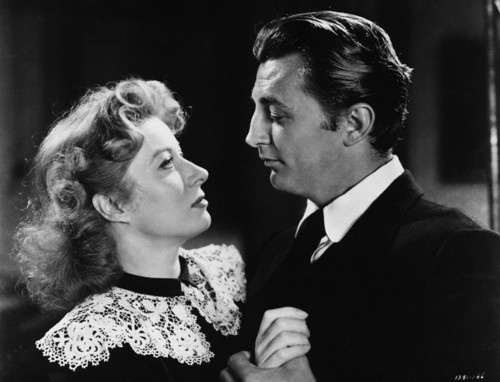
Garson and Mitchum

While the audience has their guard up and can sense the emotional instability of Jean, he gradually crosses the line from lonely to creepy, with Marise a little slow on the uptake.

The acting, disappointingly, isn't particularly note-worthy. We've all seen Garson and Mitchum in far more engrossing and challenging roles. Granted, both are gifted actors and make due with what little is given to them in the script -- but it just isn't enough to truly rise above the material. Buried deep beneath this half-wartime love story, half-psychological thriller, Desire Me has a better movie waiting to come out.

The cinematography from Joseph Ruttenberg is gorgeous, lending the film a foreboding sense of danger through his keen eye. His visuals, combined with a lack of soundtrack in the climactic finale, briefly helps Desire Me rise above its scattered script. Eyes meeting through the mist, voices echoing along the cliffs, gunshots ringing out in the night, Ruttenberg's work is stunning. His cinematography allows for a sense of consistency in a film that is a narrative mess.

Desire Me is one of those forgotten classic films that you catch on TV late one night and are reminded as to why it has been forgotten in the first place. While there are stylistic elements that are certainly impressive, Desire Me will ultimately leave you cold.

FINAL GRADE: C+

Thursday, March 7, 2013

Classic Film Review: Good News

Good News (1947)
Directed by: Charles Walters
Based on the play by: Lew Brown et al.
Starring: June Allyson and Peter Lawford

Chances are, if you are looking for a good old-fashioned musical from the 40s and 50s, your first stop would be MGM -- the major studio that produced Singin' in the Rain, The Wizard of Oz, West Side Story, Meet Me in St. Louis and Showboat, among others.

For every Gene Kelly pirouette and Judy Garland solo, there are those lesser-known gems from MGM that would otherwise be completely forgotten if not for specialty channels like TCM. 

And, considering the DVD is next to impossible to track down, TCM may be the only way classic film buffs can view (and own) director Charles Walters' thoroughly enjoyable adaptation of the college-set musical, Good News.

It's a familiar premise, one we've seen in countless musicals and romantic comedies over the decades: A college football captain named Tommy Marlowe (Peter Lawford) falls head-over-heels for the campus' beautiful, wealthy "it" girl, Pat McClellan (Patricia Marshall). When Pat rejects Tommy's advances, he discovers her passion for the French language and vows to become fluent himself in an attempt to woo her. He enlists the help of brainiac Connie Lane (June Allyson), and she sets aside time from her busy schedule to tutor him in French. And then, wouldn't you know it, Connie finds herself smitten with the star athlete. It's your standard tale of (seemingly) unrequited love set to bouncy music, vivid technicolour and show-stopping dance numbers.

All musicals require a suspension of disbelief, arguably even moreso than any other genre. People, often complete strangers, are liable to break out into a perfectly synchronized song and dance routine -- only to resume their everyday activities the moment the song reaches its concluding notes.

However, Good News unintentionally requires its viewers to suspend their disbelief even further with one particular gaping plot hole and a couple of contrived situations that strain plausibility.

The gaping plot hole? Well, that would be the fact that the film claims it's set in the 20s when, in actual fact, all the costumes and hair-styles are very clearly contemporary (i.e. circa 1947). And the plot contrivances? It would be too long-winded to list here but, in a nutshell, Tommy finds himself torn between winning the final football game of the season and proposing to Pat after the victory or losing the game on purpose to win over the affections of the bookish Connie.
Peter Lawford and June Allyson

Regardless of these quibbles, it's hard not enjoy this rousing musical. The songs are surprisingly catchy considering the film has fallen off the radar when people talk about movie musicals. You'll find yourself humming "Lucky in Love" well after the end credits. And, while "The Best Things in Life are Free" is no doubt viewed as the film's romantic highlight, keep an eye out for the amusing exchange between the charming Allyson and Lawford when they duet on "The French Lesson."

In terms of genuine show-stoppers, however, there's only one that comes to mind: "Pass the Peace Pipe", an infectious song-and-dance number led by Joan McCracken (professional dancer and ex-wife of Bob Fosse).

But what it all comes down to in the end is the two charming leads. While Allyson and Lawford both have their detractors, I'm not one of them -- they are both a joy to watch. While they may not have the greatest singing voices they try their darndest to really belt it out. Where they do both excel is in their onscreen presence and overall likeability -- and both are fully capable of burning up the dance floor as they prove in the closing number, "The Varsity Drag."

For pure, unadulterated musical entertainment, Good News proves to be just that.

FINAL GRADE: B+

Tuesday, November 6, 2012

Blu-ray Review: Sunset Blvd. (1950)

Comparing the Blu-ray transfer to the DVD release.
I reviewed this Blu-ray for Next Projection.

Cast: Gloria Swanson, William Holden and Erich von Stroheim
Director: Billy Wilder
Country: U.S.
Genre: Drama
Official Trailer: YouTube

Video
Video Codec: MPEG-4 AVC
Video resolution: 1080 p
Aspect ratio: 1.37:1
Original aspect ratio: 1.37:1

Audio
English: Dolby True HD Mono
French: Dolby Digital Mono
Spanish: Dolby Digital Mono
Portugese: Dolby Digital Mono
Subtitles: English, French, Spanish and Portugese

Sunset Blvd. finally gets its close-up on Blu-ray. As one of the most cynical glimpses of Hollywood to ever hit the silver screen, Billy Wilder's satiric masterpiece is classic cinema at its finest.

Long revered as one of the finest films ever made, this seminal work marks a career high for Wilder who, at the time, was Hollywood's most celebrated director, having recently won the Oscars for Best Director and Best Screenplay for The Lost Weekend (1945).

With its assortment of colourful characters both fictional and real, Sunset Blvd. delves into the dark side of movie-making -- from the desperation of those who seek a life in the spotlight to those jaded figures who work behind the scenes. It's a dirty business and Wilder wasn't afraid to shine a light on its dark corners.

Struggling screenwriter Joe Gillis (William Holden) is down on his luck in Hollywood and, after a series of misadventures, finds himself in a ramshackle mansion on the outskirts of town. Once inside the oppressive house Joe meets Norma Desmond (Gloria Swanson), an aging former silent screen star, and her solumn German butler Max von Mayerling (Erich von Stroheim). When Norma shows Joe a script she plans to use as her "return" to the silver screen, she enlists him as her screenwriter in exchange for money to pay off his creditors. Lost in her delusions and exaggerated sense of self-worth, Norma showers Joe with money and jewellery -- lavishing the man she believes will be her gateway back to fame.

Sunset Blvd.'s theme of opportunism and its consequences narrows in on what making movies does to people in the business.

The transfer and digital reconstruction is gorgeous, capturing the luscious light and shadows in every shot. Paramount clearly appreciated the importance of preserving this classic and celebrating its place in film lore.

There is a wealth of supplemental features, many of which were brought over from the DVD restoration that was released a decade ago. Featuring the likes of film historian Ed Sikov, actress Nancy Olson and film historian Andrew Sarris, the extras give tidbits on the behind-the-scenes issues in bringing this classic to the big screen.

The only complaint is that, after clocking in at more than two and a half hours of extras, the information doled out in the interviews tends to get a bit repetitive. Perhaps had some of the smaller supplemental features been edited together into one longer finished product than viewers wouldn't suffer from a sense of deja vu. 

Extras
This Blu-ray release includes featurettes on "Sunset Blvd.: The Beginning", "Sunset Blvd.: A Look Back", "The Noir Side of Sunset Blvd.", "Paramount in the 50s" and a deleted scene, among other bonus supplements.

Final grade: A 

Sunday, October 14, 2012

Revisiting the Classics: Alfred Hitchcock's Psycho

Anthony Perkins as Norman Bates
"We all go a little mad sometimes." 

On Thursday night my friend suggested we check out a screening of Alfred Hitchcock's 1960 horror classic, Psycho, which was playing at a local theatre.

It had been awhile since I'd last visited the Bates Motel and its man-with-severe-mother-issues owner, Norman.

I actually can't recall the last time I'd seen Psycho which makes me think it has been at least five years, if not longer. So, watching it in glorious black and white on the big screen made it feel as though I were watching it for the first time. I'd forgotten about a couple of little twists and the fact that the script (based on the novel by Robert Bloch) was chock-full of great dialogue and slow, engaging character revelations. It truly is a masterpiece of suspense and thrills. And, regardless of how many times you've seen the film, its final twist and closing shot (see photo above) is still as mesmerizing and shocking as it undoubtedly was back in 1960.

A complex psychological thriller, Psycho is celebrated in film circles as one of Hitchcock's finest -- if not his greatest -- achievements (and whether or not you think that Vertigo is technically the better film is a debate worthy of a whole separate blog post). At the age of 61, Hitchcock cobbled together his now-classic shocker on a tiny budget in a matter of weeks. With Hitchcock's knack for building tension and influential stylistic flare, Psycho is as unsettling in its premise as it is a technical marvel -- what with all those unique camera angles, intimate close-ups of his cast and that famous image of Mama Bates' skull superimposed over the crazed face of Norman as the film closes.

But one of the true revelations in Psycho is Anthony Perkins in the lead role. I'd never fully appreciated his performance until this recent viewing. He commanded the screen with a charismatically awkward performance that, on the surface, made him appear as likeable as a young boy eager to please his friends or parents. "I think I must have one of those faces you can't help believing," he tells Marion Crane (Janet Leigh) early on in the film. And you, as the audience, totally fall for it too, just like Marion. Even though you know Norman has the capability to kill, he lulls you into feeling sympathy for him -- you may even catch yourself wishing he'll get the help he so obviously needs.

The role of Norman Bates could have easily been nothing more than a stock horror character. A villain without personality. Someone lurking in the shadows who ultimately leaves no lasting impression once the credits roll. But where Perkins excels is in his ability to make you realize that Norman Bates could be anyone. Literally. He could be the man sitting next to you on the subway, or the woman walking her dog down the street. He's not some Freddy Krueger-type fantasy-villain who would stick out like a sore thumb if you saw him in a crowd of people from across the street. Perkins, with his average-joe features and shy nature, totally inhabits the character of Norman Bates.

It's an all-around fantastic performance in an already perfect psychological thriller.

Thursday, August 23, 2012

Classic Film Review: The Lady Eve

The Lady Eve (1941)
Directed by: Preston Sturges
Starring: Barbara Stanwyck and Henry Fonda

We all know the story about Eve and the forbidden fruit -- and right from the opening credits, which includes an animated snake, The Lady Eve puts a comedic spin on the biblical tale.

Jean and "Colonel" Harrington, a father-daughter card shark team (Barbara Stanwyck and Charles Coburn), set their sights on Charles Pike (Henry Fonda) the socially awkward millionaire of a brewery fortune who recently returned from a year-long snake hunting trip in the Amazon (there's that snake imagery again). Jean and the Colonel crave wealth and fame. As the Colonel says to his daughter: "Let us be crooked, but never common." Yet when Jean seduces Charles, she's shocked to discover that she's quickly falling head-over-heels in love. The temptress in her wants to continue her little game and come out on top -- with thousands in her bank account -- but her romantic side has other plans in store as she struggles to persuade her father to abandon their con.

Prior to his 1942 hit, The Palm Beach Story, director Preston Sturges co-wrote this battle-of-the-sexes romp featuring two of the biggest stars of the era. Brimming with witty dialogue and more than a few pratfalls for good measure -- as well as sexually frank innuendo that somehow slipped passed Hollywood censors -- The Lady Eve is a clever and engaging addition to the screwball genre.
Henry Fonda and Barbara Stanwyck

As the slippery dame surprised by the genuine love she feels for her target, Barbara Stanwyck gives arguably one of her finest performances. Generally known for her dramatic roles (see: Double Indemnity), she's an absolute pleasure to watch here as she engages in a battle with her own conscience. Stanwyck manages to portray her character's complexities in such believable fashion you may catch yourself wondering which side of herself she'll give in to: The card shark or the hopeless romantic? She's both effortlessly graceful and charmingly flustered.

Henry Fonda, on the other hand, conveys a vulnerability that's almost painful to watch. Barely cracking a smile -- but generating plenty of genuine laughs with his charismatic performance -- his quest for Jean's hand in marriage is his ultimate goal. Anything less and he would collapse in a ball of misery. Only Fonda could make such an awkward chap such a comedic delight.

The Lady Eve holds up remarkably well, thanks in large part to two exceptional lead performances and the assured direction from a comedy master. Its ingenious script, brisk pace, deceptive characters and sexy banter catapult The Lady Eve into the realm of the classics. It's the quintessential screwball comedy.

FINAL GRADE: A-

Tuesday, August 7, 2012

Classic Film Review: The Misfits (1961)

Montgomery Clift, Marilyn Monroe and Clark Gable
Two days ago, August 5th, marked the 50th anniversary of the death of Marilyn Monroe.

To mark the date I chose to watch John Huston's 1961 modern western, The Misfits. Instead of watching my favourite Monroe film (Some Like It Hot) I went with The Misfits because, not only is it her final appearance, it's arguably her finest performance.

The Misfits is often referred to as a "film of lasts": The last part Arthur Miller wrote for Monroe and the last film for both Monroe and Clark Gable before their untimely deaths.

Based on a screenplay by her soon-to-be-ex-husband, Arthur Miller, The Misfits follows a trio of down-on-their-luck men and the alluring woman who joins their ragtag group as they travel rodeo circuits and catch wild horses to sell in Reno, Nevada. They also spend weeks at a time wallowing in their sorrows together in a forlorn desert ranch. Each has a sad story to tell and they crave each others company as much as they sometimes seem to resent it.

Miller fashioned the part of Roslyn Tabor specifically for Monroe, and it shows. The role leaves room for Monroe to be both beautiful and complex, strong yet vulnerable. It plays to her strong points as an actress and really allows her room to just let go. Although she's mostly celebrated for her comedic talents, it's a shame she never got more dramatic roles to work with. The Misfits was a fitting final film because it was her strongest and most personal role.

The other characters each have their own issues to work through. Gay Langland (Clark Gable) is a fiercely independent loner reflecting on his past experiences as a great cowboy. Guido (Eli Wallach) is a heartbroken, embittered mechanic who hasn't been the same since the sudden death of his wife. Perce Howland (Montgomery Clift) rounds out the group as a rodeo rider who is fixated on mother figures and openly welcomes Roslyn's nurturing nature.

It's the mirroring of real life that can make a viewing of The Misfits so uncomfortable. Perhaps that's why I chose to watch it instead of some of Monroe's earlier, lighter fare. It was a sad production for everyone involved in the making of the film.
Monroe and Gable in their final scene.
At the time Monroe was in and out of rehab -- she was also in the process of finalizing her divorce from Arthur Miller. Director John Huston had a disruptive drinking and gambling problem. Monty Clift, never the same since his near-fatal car accident in 1956 and the subsequent reconstructive facial surgeries, was addicted to the prescription pills that temporarily relieved his chronic pain. And, finally, a mere few days after production ended on the film, Clark Gable passed away of a heart attack at the age of 59 -- a heart attack many blamed on what he put his body through in order to physically and mentally prepare for the role of the rundown Gay Langland.

It's themes of disappointed dreams, thwarted ambitions and broken characters served to lend the film a grim realism it didn't necessarily mean to invoke when production first got underway. As Monroe's Roslyn says at one point: "We're all dying, aren't we? All the husbands and all the wives. Every minute. And we're not teaching each other what we really know, are we?"

The role of Roslyn Tabor in The Misfits was the crowning achievement of Monroe's lengthy career. While not necessarily the best film she appeared in, her performance rang tragically true and is remembered today as a powerful final bow.

Thursday, July 12, 2012

Classic Film Review: The Palm Beach Story

The Palm Beach Story (1942)
Written & Directed by: Preston Sturges
Starring: Claudette Colbert, Joel McCrea, Rudy Vallee and Mary Astor

"You have no idea what a long-legged woman can do without doing anything."

Critics continue to hail The Palm Beach Story as a classic of the screwball comedy genre, one of its crowning achievements. The film is indeed an enjoyable diversion, albeit one that occasionally suffers from one too many scenes that distracts from the four main characters at the centre of the plot.

After five years in a seemingly happy and stable marriage, Gerry (Claudette Colbert) up and leaves her penniless husband, Tom (Joel McCrea), a struggling architect who just can't seem to make ends meet. Gerry flees to Florida for a quickie divorce, whereupon she meets the charmingly gullible John D. Hackensacker III (Rudy Vallee) and his sister, Princess Centimillia (Mary Astor). When Gerry discovers that the siblings are multi-millionaires she immediately concocts a plan that will help funnel some of their wealth into her soon-to-be-ex-husband's bank account, saving them both from a life of poverty. When a disgruntled Tom shows up looking for his wife, Gerry convinces him to play along as her brother so she can get closer to John and carry out the plan.

Writer and director Preston Sturges crafted an easy, breezy farce with cleverly witty and engaging dialogue that centres about the pursuit of wealth -- and the consequences that come with it. However, Palm Beach Story often gets a little lost in its own zaniness. The film starts off on a rocky note with an unnecessarily drawn-out set-up for Gerry and the millionaire John to meet on a train ride to Florida. Their engaging banter is too often broken up a gun club aboard the train who insist on shooting the place up after having one too many drinks. At this point the film nearly topples under the strain of its own wackiness.

However, once Gerry and John exit the train, the narrative settles into itself -- and it's a combination of Sturges' rapid-fire dialogue and his exceptional casting choices that help steer The Palm Beach Story on course.
Joel McCrae, Rudy Vallee and Claudette Colbert
As Gerry, Claudette Colbert reminds audiences of why they were so charmed by her in the earlier screwball classic, It Happened One Night (1934). The beautiful, doe-eyed actress had a knack for finding hilarity in even the smallest of gestures and its because of her talent that Gerry is such an immensely entertaining character. 

While Joel McCrea plays straight-man Tom perhaps a little too straight (never quite loosening up), Rudy Vallee nearly runs away with the film as the charismatic and socially awkward millionaire John D. Hackensacker III. Under the assumption that Colbert's Gerry is leaving her big, strong husband because of abuse, Vallee perfectly delivers one of Sturges' best lines of dialogue: "That's one of the tragedies of this life, that the men who are most in need of a beating up are always enormous." He underplays the role to perfection, his John creating a perfect balance between himself and the wild antics of the frenzied Gerry.

For the most part, The Palm Beach Story holds up well, delivering charming performances and genuine laughs. Despite a couple of missteps in the first half of the film, it's an amusing romp led by the vastly different, yet equally entertaining, performances of Colbert and Vallee.

FINAL GRADE: B+

Thursday, July 5, 2012

Classic Film Review: My Man Godfrey

My Man Godfrey (1936)
Directed by: Gregory La Cava
Starring: William Powell and Carole Lombard

With the emergence of the "screwball comedy" in the 1930s, Hollywood discovered a sure-fire way to lift the spirits of an American populace struggling to survive the Depression. Audiences sought a reprieve from their daily hardships in the form of beautiful celebrities who had an effortless ability to make them laugh and transport them to another time and place.

It has been more than 75 years since My Man Godfrey was first released, yet it's the sign of a story well told when it manages to hold up for generations of new fans.

Working from a script based on the novel by Eric Hatch, director Gregory La Cava crafted a comedic masterpiece that manages to be both a sharp social commentary on the class system of the 1930s and a laugh-out-loud farcical romp.

When spoiled socialite Irene Bullock (Carole Lombard) crosses paths with Godfrey (William Powell), a "forgotten man" living in a city dump, she convinces him to accompany her a party teeming with the creme de la creme of New York society. Her reason? To win a scavenger hunt in which one of the items listed is to return with a homeless person. Irene is instantly infatuated with the mysterious Godfrey and convinces her parents (Eugene Pallette and Alice Brady) to take him in as the new family butler -- much to her elder sister Cornelia's (Gail Patrick) distaste. Irene takes Godfrey under her wing, referring to him as her "protege", much in the same way that her own mother addresses Carlo (Mischa Auer), a young Italian man she keeps around the house for her amusement. Godfrey is forced to endure the inane antics of the Bullock family -- the most alarming issue being the shocking advances made by Irene, who seeks to woo the butler into marriage.

My Man Godfrey is like a fine wine -- it's aged remarkably well for a film so firmly ingrained in 1930s society. You laugh along with its implausible situations and clever wordplay while considering its thoughtful commentary on social order. Even its remarkable cinematography has transferred well, with Ted Tetzlaff's rich visuals jumping off the screen.
Carole Lombard and William Powell
However, it's savvy dialogue and physical comedy could have easily fallen flat in less capable hands. Luckily for audiences, La Cava's ingenious decision to cast screwball genre stalwart Carole Lombard and the charismatic William Powell paid off in spades. The fact that the two actors were once briefly married in real life prior to filming made the dynamic all the more electric.

Powell's razor-sharp delivery and straight-man comedic chops provides perfect fodder for Lombard's whimsical, slightly neurotic performance. Watching them engage in witty repartee and innuendos is the reason behind My Man Godfrey's designation as one of the greatest screwball comedies of all time. Lombard, in particular, shines in her role. In the hands of a lesser actress, the role of Irene would have come off as nothing more than a simpering brat unworthy of audience sympathy. Instead, you find yourself rooting for her happiness, despite her flaws and regardless of her obliviousness to the world around her. 

The supporting cast fares just as well as the leads, specifically the maniacal frenzy of Alice Brady as Mrs. Bullock and the amusingly over-dramatic antics of Mischa Auer in the scene-stealing role of Carlo. 

My Man Godfrey is pure unadulterated fun -- witty escapism at its finest. If only all films were this good.

FINAL GRADE: A+

Thursday, February 9, 2012

Film Noir Series: The Asphalt Jungle (1950)

My latest Film Noir Spotlight entry for Next Projection. The eight film on my list is The Asphalt Jungle (1950).

Coming off his 1949 Oscar win for The Treasure of Sierra Madre, director John Huston crafted a tightly coiled caper brimming with murder and corruption and told almost entirely from the point of view of its criminals. The Asphalt Jungle, a seminal work in Huston’s impressive filmography, has a gritty realism that sheds light on a dark corner of society.

Based on the novel by W.R. Burnett, The Asphalt Jungle zeroes in on “Doc” Erwin Riedenschneider (Sam Jaffe), a German immigrant who masterminds the ultimate score during the seven years he spent in incarceration. Funded by Alonso Emmerich (Louis Calhern), a treacherous businessman with his own set of objectives, the jewel heist is meticulously plotted. Regarded as a flawless scheme by the diminutive Doc, the puzzle pieces finally fall into place once he recruits a safecracker (Anthony Caruso), a driver (James Whitmore) and a street-savvy hooligan named Dix Handley (Sterling Hayden) whose desire for wealth masks his inherent decency. When the heist backfires and the men retreat to their own separate hiding places, The Asphalt Jungle chronicles the descent of each of them as they struggle to survive both the police task force – and each other.

There’s an artistry to the film that only someone with Huston’s impressive credentials can bring to what is, essentially, a low-budget B-movie about tough guys and their dames. With its richly textured black and white cinematography, expertly lensed by Harold Rosson, and its sparse and rundown city streets, The Asphalt Jungle has a claustrophobic documentary style. Devoid of the contrived dialogue that is often a staple in the noir genre, there are times when conversations feel almost entirely improvised and natural. With a large cast on his hands, Huston, who co-wrote the script with Ben Maddow, weaves each plot point into a deeply absorbing – and dialogue-heavy – endeavour. Following a linear narrative (the rare noir without any flashback sequences), The Asphalt Jungle is a relatively quiet urban crime drama with only brief bursts of violence and action.

The jungle – that seedy underbelly of society that lies beneath city streets – is chock-full of corruption, backstabbing and dead ends.

Marilyn Monroe
Huston’s inspired casting is most notable with his two leads – Jaffe and Hayden, as Doc and Dix. As Doc, Jaffe is quietly commanding as the cool and collected mastermind of the failed heist. Nominated for Best Supporting Actor, Jaffe brings a softer approach to a role that is traditionally filled by a “tough-guy” thug. Meanwhile, Hayden stands out with his performance as Dix – an idealist whose life comes crashing down around him as the jungle swallows him whole.

A woman’s touch is keenly felt with two electric supporting performances from Jean Hagen and a then-unknown Marilyn Monroe. Hagen is the standout as Dix’s long-suffering girlfriend, Doll Conovan. In one notable scene, Hagen, in the middle of an emotional breakdown, rips her fake eyelashes off, while mascara drips down her face and mingles with her tears. Her nervous smile, always so eager to please Dix, is heartbreaking in its poignant honesty. Monroe is a knockout as the much-older Emmerich’s mistress, Angela. Beautiful and vulnerable, Monroe shines, giving audiences a glimpse of the star she was later to become.

One of the few downfalls in a film with a plot as crammed with characters as The Asphalt Jungle is that the character development of some of the other players falls short. There’s also the underwritten role of Commissioner Hardy (John McIntire), a preachy moralist who is inserted into the film simply to counter the actions of its central figures. As Hardy sermonizes to his police troops: “Suppose we had no police force, good or bad …Nobody to listen, nobody to answer. The battle's finished. The jungle wins. The predatory beasts take over.” It’s excess baggage that weighs down an otherwise tight script.

But those “predatory beasts” that Hardy rants against are very regular people making very big mistakes – tough guys and their dames, just trying to make it in the world by any means possible.

Welcome to the jungle.

FINAL GRADE: A-

Saturday, January 28, 2012

Film Noir Series: Gun Crazy (1950)

My latest Film Noir Spotlight entry for Next Projection. The seventh film on my list is Gun Crazy (1950).

A gun-crazy man sets his sights on a dangerous dame. Their shared infatuation with pistols – memorably captured in one of the most bizarre seduction sequences in American cinema – results in a whirlwind of criminal activity for this trigger-happy pair. A precursor to Arthur Penn’s 1967 classic Bonnie & Clyde, Gun Crazy is a stunning technical achievement capped off with two electric lead performances.

Originally released in 1950 as Deadly is the Female, the film came and went, rapidly falling off the radar when critics panned it and audiences failed to show up. Later re-titled as Gun Crazy, director Joseph H. Lewis’ once underrated gem is now recognized in films circles as an innovative crime drama that has since been included in the National Film Registry.

As a youth, Bart Tare (a young Russ Tamblyn) is sentenced to time in a reform school and, later, a stint in the military, after stealing a pistol. The aimless, gun-obsessed youth grows into an aimless, gun-obsessed adult (John Dall). His first day of freedom starts with time spent at a carnival with two former childhood pals and ends with him falling head-over-heels in love with an English sharpshooter named Annie “Laurie” Starr (Peggy Cummins). Their intense attraction is mutual and the two quickly wed and set out for a life spent robbing banks. Gun Crazy is an unfettered social commentary on gun worship in America. Based on a short story by MacKinlay Kantor, the film crackles with barely contained energy, fuelled by the chemistry between Dall and Cummins.

Lewis insisted on giving his actors breathing room, encouraging them to improvise dialogue, specifically during their heist scenes. The main bank robbery sequence at the centre of the film was shot in one long take from the backseat of the getaway car. Equipped with a groundbreaking portable camera, it elevated Gun Crazy above and beyond what a typical B-movie could achieve. It’s a beautifully executed series of events, from robbery to getaway, which later influenced the likes of Arthur Penn and Quentin Tarantino. You’re just grateful that, as an audience, you feel as if you’re an accessory to their crimes.

John Dall and Peggy Cummins in Gun Crazy
Bart is a killer shot, but he’s no killer. His love for guns contradicts his discomfort with the notion of murder. His years in the military didn’t harden him in that regard. Emotionally fragile, yet twitchy in his constant need to reach for his gun, Bart is a quietly sympathetic figure. He sees his gun as an extension of himself – his reason for living; that is, until he meets Laurie. He’s a fundamentally decent man who is easily swayed by a dangerous woman: in short, the archetypal noir protagonist. As Bart, the lanky and jittery Dall gives a charming performance; imagine Jimmy Stewart as a Clyde Barrow-type.

As Laurie, one of the most dominant femmes you’re likely to come across in a noir, Cummins is dynamite – both sexy and vulnerable, she exudes a fiery confidence. She hints at a violent past, but her nature is more primitive and bloodthirsty than even Bart knows. She’s an alluring enigma but her love for Bart is undeniably genuine, an interesting twist on the traditional femme fatale.

Dall and Cummins exude a raw sexuality rarely seen in American cinema at the time. Their romance is so believable that the quieter scenes they share together are just as compelling as their bank robberies. As Bart tells Laurie, they go together “like guns and ammunition.”

Gun Crazy remains as fresh and thrilling as it was during its initial release. It’s one of those quietly heralded Hollywood pictures that few audiences have seen. It deserves to be dissected, discussed and admired for its technical achievements and largely improvised performances from the exceptional Dall and Cummins. Captivating from start to finish, Gun Crazy is must-see cinema for any film connoisseur. It’s as entertaining as it is influential.

FINAL GRADE: A+ 

Friday, January 13, 2012

Film Noir Series: The Set-Up (1949)

Robert Ryan as Stoker Thompson
My latest Film Noir Spotlight entry for Next Projection. The sixth film on my list is The Set-Up (1949).

Before there was Raging Bull, there was The Set-Up, Robert Wise’s brutally devastating glimpse into one night in the life of an aging, struggling boxer. It’s no great surprise, then, to hear Martin Scorsese waxing poetic about the influential merit of the film on the DVD’s commentary track. The Set-Up is a potent noir classic; a gritty documentary-type film made well before such a style even existed.

Right from the opening frame, it sets itself apart from other Hollywood releases in the late-1940s. Devoid of any soundtrack, the opening credits pan over a brutal fight in a boxing ring – a perverse, violent “dance” that only ends when one man is finally knocked out, to the crowd’s roaring approval. Robert Wise, a director often associated with his upscale musicals like West Side Story (1961) and The Sound of Music (1965), zeros in on the sights and sounds of a boxing match to recreate an authentic atmosphere.

Based on a Joseph Moncure March poem (which, in actuality, had a black ex-convict at the heart of its narrative, not a white boxer), The Set-Up moves along briskly in real time. At 35 years of age, Bill ‘Stoker’ Thompson (Robert Ryan) is considered “over-the-hill” by the bloodthirsty mobs that flock to the sweat-drenched boxing matches at the Paradise City arena. His own manager (George Tobias) is so sure that Stoker will go down in his match that he takes “dive” money from a gambler who goes by the pseudonym Little Boy (Alan Baxter) – and neglects to inform Stoker. Despite desperate pleas from his wife, Julie (Audrey Totter), to retire, Stoker insists he has one more big fight left in him.

The film unfurls slowly, gradually familiarizing the audience with Stoker as he prepares for his duel in the ring against a much younger opponent. With its revolving door of compelling secondary characters, all of whom offer their own personal tales of woe and victory, The Set-Up is a stripped down tale of the physical and psychological struggles of men like Stoker. All the boxers in the room are big dreamers although, judging from their anxious chatter, they are all too aware that their one-time shot at fame is fleeting.

Lensed by cameraman Milton Krasner, you can practically smell the stale air and feel each punch thrown. Alternating between intimately brutal, bloody close-ups and jarring wide shots, the fight scenes demonstrate both stunning choreography on the part of the actors and superior camerawork by the crew. Like gladiators in the Coliseum, the men in the ring are modern day warriors, complete with a powerful fan base that can be heard screaming and stomping from their dressing room. The crowd is comprised of those who place the bets and those who just love a bloody exhibition – like the blind man who has his friend narrate the fight sequences and the housewife who embarrasses her husband by screaming obscenities in her quest for more blood.

With his weathered features – complete with cauliflower ears, five o’clock shadow and upper lip sweat – Ryan breathes life into the role of Stoker. Considering his years as a boxer in college prior to acting, Ryan is a natural, carrying himself like a battered, yet determined, athlete. Looking as though he carries the weight of the world on his shoulders, Ryan gives a remarkable performance. His Stoker is one of the finest incarnations of a struggling athlete in film. His scenes with Audrey Totter as his wife, Julie, are particularly compelling, adding depth to both of their characterizations.

The Set-Up remains a startlingly raw slice-of-life narrative that more than earns its place as an influential noir classic. It balances a superbly crafted story with exquisitely choreographed fight sequences, all of which is anchored by an understated, naturalistic performance from Robert Ryan. It’s a knockout.

FINAL GRADE: A+


Saturday, January 7, 2012

Film Noir Series: Born to Kill (1947)


My latest Film Noir Spotlight entry over at Next Projection. You can check out the review HERE. The fifth film on my list is Born to Kill (1947).
A beautiful woman watches a tall, brooding man playing a game of craps at a casino. She watches him out of the corner of her eye as he rolls the pair of dice. When their eyes eventually meet, the man’s mouth lifts into a tiny smile. This wordless exchange lasts only a couple of moments, but the powerful connection between the two leads at the centre of Born to Kill is undeniably palpable.
Based on the James Gunn pulp novel, Deadlier Than The Male, this oft-overlooked noir is arguably one of the nastiest incarnations of the genre. Adapted for the screen by Eve Greene and Richard Macaulay, Born to Kill goes against type by featuring a female in the lead – a woman just as despicable as her male counterpart. This unconventional noir doesn’t rely on the familiar tropes of the genre. The film is devoid of any flashback narratives or voice-overs provided by a down-on-his luck private eye. Instead, the plot revolves around the two villains at the centre, one of whom happens to be a man with a seductive edge.
Beautiful socialite Helen Brent (Claire Trevor) finds her soul mate in the form of a psychotic murderer named Sam Wild (Lawrence Tierney). After her first glimpse of him at the casino, she’s drawn to his dark good looks and finds his grim persona irresistible. When she discovers that Sam is behind the grisly murder of an acquaintance, Helen keeps her lips sealed, preferring instead to recount the bloody scene with him privately, with breathless passion. It’s violence as foreplay for Helen and Sam. In a reversal from the traditional femme fatale seducing the lead male, it’s actually Helen who can’t help but get caught up in Sam’s tangled web of violence and deceit. There’s just something about Sam that immediately draws a person to his side – everyone agrees to help him get away with murder, from his loyal friend Marty (Elisha Cook Jr.) to Helen’s own foster sister, Georgia (Audrey Long).
Lawrence Tierney and Claire Trevor
Despite its stationary camera, the visuals in Born to Kill create a compelling, sometimes haunting, atmosphere – whether it’s a shot of dark shadows obscuring the corpse of a young woman or the image of Sam menacingly crouched in a corner of the room only moments before committing a double murder. Such visuals serve only to heighten the tension, more than making up for the films often-static camerawork.
As Helen, Claire Trevor is nothing short of a revelation. Her barely concealed desire for Sam and her flippant attitude towards his violent nature touch on the dark recesses of her own soul. She hides her true nature beneath a warm and welcoming exterior, a façade that only begins to crack when her own freedom, or that of Sam’s, is under serious threat. As one character tells her: “You’re the coldest iceberg of a woman I ever saw.” Shrewd and manipulative, Helen takes what she wants and it’s a pleasure watching Trevor triumph in the role. She’s so good that you’ll catch yourself rooting for Helen.
Despite not being a strong enough actor to bring out the smaller nuances in the character of Sam, Lawrence Tierney is still strangely alluring in the role. We don’t know why Sam is so angry, only that he’s a hardened sociopath who can “make people or break them.”
In the minor role of private investigator Matthew Arnett, Austrian actor Walter Slezak excels as portraying the sleazy underbelly of a man less interested in justice and more interested in monetary gains. Although the role is under-written, Slezak succeeds at portraying yet another loathsome character in a film full of such types.
With two mesmerizingly evil lead characters, Born to Kill manages to wade through its melodrama to present an exciting and unconventional noir that is both dark and deliciously wicked. 
FINAL GRADE: A-

Saturday, December 24, 2011

Movie Rant: Why I love the 1951 version of A Christmas Carol

While doing some holiday movie research for an article and slideshow I was putting together for work awhile back I came to the realization that Charles Dickens' classic short story, A Christmas Carol has been adapted at least 50 times since the invention of moving pictures. I think anyone would be hard-pressed to find another story that has been adapted more often into film and television specials than that!

I know plenty of people who love a wide range of adaptations, most notably A Muppet Christmas Carol and Bill Murray's Scrooged. While both films are fun holiday flicks in their own right, I prefer my Scrooge straight up mean and nasty -- all the better to make his conversion at the end have more of a meaningful impact.

Which brings me to the 1951 Brian Desmond Hurst adaptation starring Alastair Sim in the title role. Arguably the finest version of how the miserly Ebenezer Scrooge re-discovered his Christmas spirit and restored his reputation, a lot of credit is due to the performance of Sim. The man was born to play Scrooge -- the craggy-faced Scottish native perfectly captures all of the characters' multitude of emotions, from hardened and world weary to childlike wonder. Regardless of how many times I've seen this film, his jubilant Christmas morning jig towards the end always makes me smile.

When I was about eight years old, my mom introduced this classic adaptation to my sister and I. It was in black and white. It made cracking and popping sounds because of a poor VHS transfer. It had long lines down the screen from where the original film was scratched. And, from that young age of eight, I still managed to become hooked, despite everything going against it. It soon became a Christmas Eve tradition -- the night before Christmas, we'd sit around the TV and watch Scrooge transform into a caring and compassionate human being who learned "how to keep Christmas well." 


Alastair Sim as Ebenezer Scrooge
I can't think of another version (and I've seen many) that so accurately captures the true holiday spirit of Dickens' story. It's dark, it's sad, it's charming and it's ultimately what Christmas is all about -- putting differences aside and spending time with loved ones.

There's something to be said for a story that has endured for so many generations -- it's clear that Dickens hit a nerve when he first published his novella. I even wrote about the phenomenon for last years holiday issue of History Magazine ("How Charles Dickens Saved Christmas"). Every great piece of fiction deserves a worthy film adaptation should people decide to translate it onto the silver screen and the 1951 version of A Christmas Carol is just that.

So, later on tonight, once my family and I have returned from our Christmas Eve dinner with one side of our extended family, we'll curl up on the couch and watch A Christmas Carol once again. Twenty years after watching it for the first time, it's still my favourite way to unwind on Christmas Eve before the hustle and bustle of the big day.

Merry Christmas!