Showing posts with label classic film review. Show all posts

Friday, April 26, 2013

Classic Film Review: Meet Me In St. Louis

Meet Me in St. Louis (1944)
Directed by: Vincente Minnelli
Starring: Judy Garland, Margaret O'Brien and Mary Astor

Meet Me in St. Louis -- one of those big, bold musicals from MGM that, to this day, remain a classic example of how to incorporate song and dance when weaving together a story.

The picture itself is a slice of life -- one year in the life, to be exact, of the Smith family (the last name chosen, presumably, to imply normalcy. This is your everyday, average, relatable family).

For the Smith clan, music is a part of everyday life. When someone breaks into song, they are actually doing it -- and everyone either gathers around to listen or joins in with their own lyrics. Unlike some musicals, where the songs are simply an expression of emotion that doesn't necessarily mean the characters are actually singing within the context of the narrative, the Smith's in Meet Me in St. Louis are similar to the von Trapps in The Sound of Music -- all aspects of life, whether good or bad, are worth singing about. And isn't life just grand?

The opening number, named after the film's title, starts with the sounds of a little girl humming as she walks upstairs in preparation for her afternoon bath. When she eventually breaks into song, her Grandpa chims in, before the song carries out the front window and continues with Judy Garland pulling up to the house in horse and buggy.

Set in 1903, the narrative follows the highs and lows of the Smith family -- from falling in love, to dangerous Halloween stunts to Christmas miracles. The simplicity of the story is ultimately made extraordinary by its catchy musical numbers. And, really, can anyone else sing like the legendary Judy Garland?

As Esther Smith, second eldest daughter to Alonzo (Leon Ames) and Anna (Mary Astor), Garland is a revelation. Not only does her voice carry the emotional weight necessary for the role, but her natural interactions with her co-stars make you forget you are watching a big star and not just some regular girl from down the street. And that's a high compliment.

Whether she's longingly singing about her (at first) unrequited love for John Truett (Tom Drake) in "The Boy Next Door" or simply horsing around with her sisters Rose (Lucille Bremer) and little Tootie (the always adorable Margaret O'Brien), Garland infuses each scene with her contagious energy and charisma. You can't create that kind of natural talent and Garland has it in spades.

Margaret O'Brien (left) and Judy Garland
Meet Me in St. Louis is the rare female-centric musical where the boys are secondary and take a backseat to sisterly bonds and rebellious feminine spirit. In Hollywood, where male characters tend to be more well written than females (a problem we still see to this day), it's refreshing to see John, the main romantic lead, come off as an underdeveloped drip in comparison to Esther and the other lady Smiths. And even though Esther pines over John (although we are never quite sure what she sees in him), she makes him really work for her affection, even taking a bite out of his arm in anger at one point.

The songs are all upbeat and catchy -- specifically "The Trolley Song" -- and director Vincente Minnelli expertly lenses all the beautiful costumes and choreography. It's one of the most strikingly vivid films you are likely to see.

However, much of the pleasure viewers will derive from Meet Me in St. Louis is its charming central family. One scene, early on, subtly provides insight into their familial closeness when the entire Smith clan tries to calmly eat dinner even though they know full-well that Rose is expecting a long-distance phone call from a male admirer who may or may not propose to her (and on the newest advancement in technology, to boot!). Their excited and nervous energy around the dinner table -- and their honest-to-goodness happiness when the young suitor finally phones Rose -- illustrates that bond with very little fuss.

It's this attention to the little details where Minnelli excels. It's all about the small moments in life and Minnelli takes great care to illustrate the love that binds the Smith's together. Regardless of what is happening in the great world outside their borders, their relationships, built on solid foundation, is what keeps them going everyday.

As Tootie remarks, "Wasn't I lucky to be born in my favourite city?"

That kind of innocence and the pleasure the Smith's take in their safe little existence provides this rousing musical with a beating heart at its core.

FINAL GRADE: B+

Monday, April 8, 2013

Classic Film Review: Julia Misbehaves

Julia Misbehaves (1948)
Directed by: Jack Conway
Starring: Greer Garson, Walter Pidgeon, Peter Lawford and Elizabeth Taylor

It was the rare Hollywood film that featured a female lead that abandoned her husband and baby to pursue a career as a music hall performer. But thus is the premise of the MGM comedy, Julia Misbehaves.

After completing a series heavy dramas, British star Greer Garson turned her talents to performing in a light comedy -- one that sees her sing, dance and throw around zingers like the best in the business.

Julia Packett (Garson) hasn't seen her estranged husband (Walter Pidgeon) or daughter Susan (Elizabeth Taylor, only 16 years old at the time) in nearly 20 years. While William raises Susan in Paris as a single parent, Julia traipses around the world, basking in the glow of the spotlight and her most ardent fans. When she unexpectedly receives an invitation to her daughter's impending nuptials, Julia is both shocked and touched by this act of kindness and familiarity. As she barters her way to secure passage on a steerage ship -- and vows to win enough money gambling to buy Susan Christmas presents for every year that she's missed since her birth -- Julia finds herself firmly embedded in everyone's lives the minute she lands in Paris. Her constant meddling leaves William on the verge of madness, especially when Julia gently nudges Susan away from her betrothed and into the direction of Ritchie (Peter Lawford), a young artist who not-so-secretly pines over Susan. And, despite her brash nature and matchmaking schemes, William can't help but fall back in love with the woman who left him all those years ago.

Julia Misbehaves is part screwball comedy and part family drama, with a dash of romance thrown in for good measure. It's the type of crowd-pleasing concoction that made MGM a household name. Although the audience knows that the film will inevitably have a happy ending -- not only for Julia and William but Susan and Ritchie, as well -- you take pleasure in watching all the loose threads come together.
(Left to right): Lawford, Taylor, Pidgeon and Garson.
Garson, in particular, exhibits an innate ability to convey a multitude of emotions in a single glance. Witness her fragility in the scene where she is reunited with Susan for the first time since the girl was a newborn baby. Swathed in a white dress, Julia has abandoned any semblence to her former life as an entertainer. And, despite the fact that she ran off all those years ago, a natural maternal instinct kicks into gear when she locks eyes with Susan and she can't help but reach out to the young woman and desire a close mother-daughter bond.

And while it takes nearly 45 minutes before Garson and Pidgeon unite on screen, watching them navigate through the awkwardness of being married to a complete stranger is a delight to watch. Their relationship -- what little of it once existed -- is gradually revealed through their blossoming friendship. When Julia and William sing together at the piano it's as though they haven't spent nearly 20 years apart.

And while you watch the film for Garson and Pidgeon, you also stay for Taylor and Lawford. With two romantic plotlines, Julia Misbehaves nearly topples under the weight of too many story threads and stolen glances, but it's a joy to watch four young actors pair off and fall in love. And kudos to whoever crafted the idea that Ritchie take Susan on a picnic and lure a bear to follow them so that he can act the part as her saviour and protector. That's a new one! And Taylor and Lawford are charming in the scene.

In the end, Julia Misbehaves suffers from a meandering script (with multiple plotlines that involve a fake fiance for Julia, an extended stage sequence that drags on for far too long and a couple of false endings), yet manages to stay afloat thanks in large part to Garson and her charming costars.

A fun, if unremarkable, little comedy.

FINAL GRADE: B-

Tuesday, March 26, 2013

Classic Film Review: Desire Me

Desire Me (1947)
Directed by: No director's credit
Starring: Greer Garson, Richard Hart and Robert Mitchum

It's pretty safe to say that, well before the end of production on Desire Me, no one wanted to have anything to do with this oft-overlooked picture.

The specialty channel TCM aired the film last week, with host Robert Osborne detailing the multiple cast changes, script rewrites and revolving door of high-profile directors that all culminated in the film's ultimate plummet at the box office. Few remember the film today. This is not the picture that Greer Garson or Robert Mitchum are remembered for, thankfully.

In fact, the most intriguing thing about Desire Me is the fact that it was the first MGM film to be released without a director's name attached. Jack Conway, George Cukor, Mervyn LeRoy and Victor Saville all took a stab at helming the project, but ultimately left for a myriad of reasons -- namely the lack of artistic freedom and Garson's allegedly difficult personality on set.

It was LeRoy who finished the picture in the end, however, none of the directors wanted their names attached to the film so the studio went ahead and released it without crediting anyone.

Desire Me begins with an isolated house set upon the cliffs in Brittany. With a setting more suited to a film adaptation of Wuthering Heights, we discover that it belongs to Marise Aubert (Garson), a woman who is led to believe that her husband, Paul (Mitchum), has died in the field during the Second World War. When a man appears by the name of Jean Renaud (Richard Hart) he claims that he was her husband's closest companion during the war and that he witnessed Paul's death. Marise finds herself drawn to this personable stranger and sets out to lead a life with him as though he were a replacement for her dead husband. Marise and Jean's friendship is frowned upon by the gossipy villagers -- how could two unmarried strangers live together under one roof? As we learn via flashback, Jean is more than content with this living situation, having fallen in love with Marise based on a photo of her and Paul's stories about his loving wife.

As Jean himself claims in one particularly eerie moment: "I wanted to know what it was like to come home to my own house. My own wife."
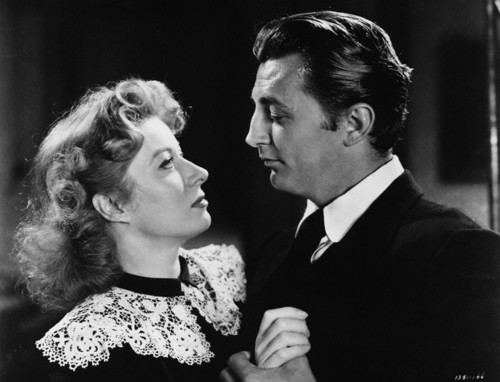
Garson and Mitchum

While the audience has their guard up and can sense the emotional instability of Jean, he gradually crosses the line from lonely to creepy, with Marise a little slow on the uptake.

The acting, disappointingly, isn't particularly note-worthy. We've all seen Garson and Mitchum in far more engrossing and challenging roles. Granted, both are gifted actors and make due with what little is given to them in the script -- but it just isn't enough to truly rise above the material. Buried deep beneath this half-wartime love story, half-psychological thriller, Desire Me has a better movie waiting to come out.

The cinematography from Joseph Ruttenberg is gorgeous, lending the film a foreboding sense of danger through his keen eye. His visuals, combined with a lack of soundtrack in the climactic finale, briefly helps Desire Me rise above its scattered script. Eyes meeting through the mist, voices echoing along the cliffs, gunshots ringing out in the night, Ruttenberg's work is stunning. His cinematography allows for a sense of consistency in a film that is a narrative mess.

Desire Me is one of those forgotten classic films that you catch on TV late one night and are reminded as to why it has been forgotten in the first place. While there are stylistic elements that are certainly impressive, Desire Me will ultimately leave you cold.

FINAL GRADE: C+

Thursday, March 7, 2013

Classic Film Review: Good News

Good News (1947)
Directed by: Charles Walters
Based on the play by: Lew Brown et al.
Starring: June Allyson and Peter Lawford

Chances are, if you are looking for a good old-fashioned musical from the 40s and 50s, your first stop would be MGM -- the major studio that produced Singin' in the Rain, The Wizard of Oz, West Side Story, Meet Me in St. Louis and Showboat, among others.

For every Gene Kelly pirouette and Judy Garland solo, there are those lesser-known gems from MGM that would otherwise be completely forgotten if not for specialty channels like TCM

And, considering the DVD is next to impossible to track down, TCM may be the only way classic film buffs can view (and own) director Charles Walters' thoroughly enjoyable adaptation of the college-set musical, Good News.

It's a familiar premise, one we've seen in countless musicals and romantic comedies over the decades: A college football captain named Tommy Marlowe (Peter Lawford) falls head-over-heels for the campus' beautiful, wealthy "it" girl, Pat McClellan (Patricia Marshall). When Pat rejects Tommy's advances, he discovers her passion for the French language and vows to become fluent himself in an attempt to woo her. He enlists the help of brainiac Connie Lane (June Allyson), and she sets aside time from her busy schedule to tutor him in French. And then, wouldn't you know it, Connie finds herself smitten with the star athlete. It's your standard tale of (seemingly) unrequited love set to bouncy music, vivid technicolour and show-stopping dance numbers.

All musicals require a suspension of disbelief, arguably even moreso than any other genre. People, often complete strangers, are liable to break out into a perfectly synchronized song and dance routine -- only to resume their everyday activities the moment the song reaches its concluding notes.

However, Good News unintentionally requires its viewers to suspend their disbelief even further with one particular gaping plot hole and a couple of contrived situations that strain plausibility.

The gaping plot hole? Well, that would be the fact that the film claims it's set in the 20s when, in actual fact, all the costumes and hair-styles are very clearly contemporary (i.e. circa 1947). And the plot contrivances? It would be too long-winded to list here but, in a nutshell, Tommy finds himself torn between winning the final football game of the season and proposing to Pat after the victory or losing the game on purpose to win over the affections of the bookish Connie.
Peter Lawford and June Allyson

Regardless of these quibbles, it's hard not enjoy this rousing musical. The songs are surprisingly catchy considering the film has fallen off the radar when people talk about movie musicals. You'll find yourself humming "Lucky in Love" well after the end credits. And, while "The Best Things in Life are Free" is no doubt viewed as the film's romantic highlight, keep an eye out for the amusing exchange between the charming Allyson and Lawford when they duet on "The French Lesson."

In terms of genuine show-stoppers, however, there's only one that comes to mind: "Pass the Peace Pipe", an infectious song-and-dance number led by Joan McCracken (professional dancer and ex-wife of Bob Fosse).

But what it all comes down to in the end is the two charming leads. While Allyson and Lawford both have their detractors, I'm not one of them -- they are both a joy to watch. While they may not have the greatest singing voices they try their darndest to really belt it out. Where they do both excel is in their onscreen presence and overall likeability -- and both are fully capable of burning up the dance floor as they prove in the closing number, "The Varsity Drag."

For pure, unadulterated musical entertainment, Good News proves to be just that.

FINAL GRADE: B+

Thursday, August 23, 2012

Classic Film Review: The Lady Eve

The Lady Eve (1941)
Directed by: Preston Sturges
Starring: Barbara Stanwyck and Henry Fonda

We all know the story about Eve and the forbidden fruit -- and right from the opening credits, which includes an animated snake, The Lady Eve puts a comedic spin on the biblical tale.

Jean and "Colonel" Harrington, a father-daughter card shark team (Barbara Stanwyck and Charles Coburn), set their sights on Charles Pike (Henry Fonda) the socially awkward millionaire of a brewery fortune who recently returned from a year-long snake hunting trip in the Amazon (there's that snake imagery again). Jean and the Colonel crave wealth and fame. As the Colonel says to his daughter: "Let us be crooked, but never common." Yet when Jean seduces Charles, she's shocked to discover that she's quickly falling head-over-heels in love. The temptress in her wants to continue her little game and come out on top -- with thousands in her bank account -- but her romantic side has other plans in store as she struggles to persuade her father to abandon their con.

Prior to his 1942 hit, The Palm Beach Story, director Preston Sturges co-wrote this battle-of-the-sexes romp featuring two of the biggest stars of the era. Brimming with witty dialogue and more than a few pratfalls for good measure -- as well as sexually frank innuendo that somehow slipped passed Hollywood censors -- The Lady Eve is a clever and engaging addition to the screwball genre.
Henry Fonda and Barbara Stanwyck

As the slippery dame surprised by the genuine love she feels for her target, Barbara Stanwyck gives arguably one of her finest performances. Generally known for her dramatic roles (see: Double Indemnity), she's an absolute pleasure to watch here as she engages in a battle with her own conscience. Stanwyck manages to portray her character's complexities in such believable fashion you may catch yourself wondering which side of herself she'll give in to: The card shark or the hopeless romantic? She's both effortlessly graceful and charmingly flustered.

Henry Fonda, on the other hand, conveys a vulnerability that's almost painful to watch. Barely cracking a smile -- but generating plenty of genuine laughs with his charismatic performance -- his quest for Jean's hand in marriage is his ultimate goal. Anything less and he would collapse in a ball of misery. Only Fonda could make such an awkward chap such a comedic delight.

The Lady Eve holds up remarkably well, thanks in large part to two exceptional lead performances and the assured direction from a comedy master. Its ingenious script, brisk pace, deceptive characters and sexy banter catapult The Lady Eve into the realm of the classics. It's the quintessential screwball comedy.

FINAL GRADE: A-

Tuesday, August 7, 2012

Classic Film Review: The Misfits (1961)

Montgomery Clift, Marilyn Monroe and Clark Gable
Two days ago, August 5th, marked the 50th anniversary of the death of Marilyn Monroe.

To mark the date I chose to watch John Huston's 1961 modern western, The Misfits. Instead of watching my favourite Monroe film (Some Like It Hot) I went with The Misfits because, not only is it her final appearance, it's arguably her finest performance.

The Misfits is often referred to as a "film of lasts": The last part Arthur Miller wrote for Monroe and the last film for both Monroe and Clark Gable before their untimely deaths.

Based on a screenplay by her soon-to-be-ex-husband, Arthur Miller, The Misfits follows a trio of down-on-their-luck men and the alluring woman who joins their ragtag group as they travel rodeo circuits and catch wild horses to sell in Reno, Nevada. They also spend weeks at a time wallowing in their sorrows together in a forlorn desert ranch. Each has a sad story to tell and they crave each others company as much as they sometimes seem to resent it.

Miller fashioned the part of Roslyn Tabor specifically for Monroe, and it shows. The role leaves room for Monroe to be both beautiful and complex, strong yet vulnerable. It plays to her strong points as an actress and really allows her room to just let go. Although she's mostly celebrated for her comedic talents, it's a shame she never got more dramatic roles to work with. The Misfits was a fitting final film because it was her strongest and most personal role.

The other characters each have their own issues to work through. Gay Langland (Clark Gable) is a fiercely independent loner reflecting on his past experiences as a great cowboy. Guido (Eli Wallach) is a heartbroken, embittered mechanic who hasn't been the same since the sudden death of his wife. Perce Howland (Montgomery Clift) rounds out the group as a rodeo rider who is fixated on mother figures and openly welcomes Roslyn's nurturing nature.

It's the mirroring of real life that can make a viewing of The Misfits so uncomfortable. Perhaps that's why I chose to watch it instead of some of Monroe's earlier, lighter fare. It was a sad production for everyone involved in the making of the film.
Monroe and Gable in their final scene.
At the time Monroe was in and out of rehab -- she was also in the process of finalizing her divorce from Arthur Miller. Director John Huston had a disruptive drinking and gambling problem. Monty Clift, never the same since his near-fatal car accident in 1956 and the subsequent reconstructive facial surgeries, was addicted to the prescription pills that temporarily relieved his chronic pain. And, finally, a mere few days after production ended on the film, Clark Gable passed away of a heart attack at the age of 59 -- a heart attack many blamed on what he put his body through in order to physically and mentally prepare for the role of the rundown Gay Langland.

It's themes of disappointed dreams, thwarted ambitions and broken characters served to lend the film a grim realism it didn't necessarily mean to invoke when production first got underway. As Monroe's Roslyn says at one point: "We're all dying, aren't we? All the husbands and all the wives. Every minute. And we're not teaching each other what we really know, are we?"

The role of Roslyn Tabor in The Misfits was the crowning achievement of Monroe's lengthy career. While not necessarily the best film she appeared in, her performance rang tragically true and is remembered today as a powerful final bow.

Thursday, July 12, 2012

Classic Film Review: The Palm Beach Story

The Palm Beach Story (1942)
Written & Directed by: Preston Sturges
Starring: Claudette Colbert, Joel McCrea, Rudy Vallee and Mary Astor

"You have no idea what a long-legged woman can do without doing anything."

Critics continue to hail The Palm Beach Story as a classic of the screwball comedy genre, one of its crowning achievements. The film is indeed an enjoyable diversion, albeit one that occasionally suffers from one too many scenes that distracts from the four main characters at the centre of the plot.

After five years in a seemingly happy and stable marriage, Gerry (Claudette Colbert) up and leaves her penniless husband, Tom (Joel McCrea), a struggling architect who just can't seem to make ends meet. Gerry flees to Florida for a quickie divorce, whereupon she meets the charmingly gullible John D. Hackensacker III (Rudy Vallee) and his sister, Princess Centimillia (Mary Astor). When Gerry discovers that the siblings are multi-millionaires she immediately concocts a plan that will help funnel some of their wealth into her soon-to-be-ex-husband's bank account, saving them both from a life of poverty. When a disgruntled Tom shows up looking for his wife, Gerry convinces him to play along as her brother so she can get closer to John and carry out the plan.

Writer and director Preston Sturges crafted an easy, breezy farce with cleverly witty and engaging dialogue that centres about the pursuit of wealth -- and the consequences that come with it. However, Palm Beach Story often gets a little lost in its own zaniness. The film starts off on a rocky note with an unnecessarily drawn-out set-up for Gerry and the millionaire John to meet on a train ride to Florida. Their engaging banter is too often broken up a gun club aboard the train who insist on shooting the place up after having one too many drinks. At this point the film nearly topples under the strain of its own wackiness.

However, once Gerry and John exit the train, the narrative settles into itself -- and it's a combination of Sturges' rapid-fire dialogue and his exceptional casting choices that help steer The Palm Beach Story on course.
Joel McCrae, Rudy Vallee and Claudette Colbert
As Gerry, Claudette Colbert reminds audiences of why they were so charmed by her in the earlier screwball classic, It Happened One Night (1934). The beautiful, doe-eyed actress had a knack for finding hilarity in even the smallest of gestures and its because of her talent that Gerry is such an immensely entertaining character. 

While Joel McCrea plays straight-man Tom perhaps a little too straight (never quite loosening up), Rudy Vallee nearly runs away with the film as the charismatic and socially awkward millionaire John D. Hackensacker III. Under the assumption that Colbert's Gerry is leaving her big, strong husband because of abuse, Vallee perfectly delivers one of Sturges' best lines of dialogue: "That's one of the tragedies of this life, that the men who are most in need of a beating up are always enormous." He underplays the role to perfection, his John creating a perfect balance between himself and the wild antics of the frenzied Gerry.

For the most part, The Palm Beach Story holds up well, delivering charming performances and genuine laughs. Despite a couple of missteps in the first half of the film, it's an amusing romp led by the vastly different, yet equally entertaining, performances of Colbert and Vallee.

FINAL GRADE: B+

Thursday, July 5, 2012

Classic Film Review: My Man Godfrey

My Man Godfrey (1936)
Directed by: Gregory La Cava
Starring: William Powell and Carole Lombard

With the emergence of the "screwball comedy" in the 1930s, Hollywood discovered a sure-fire way to lift the spirits of an American populace struggling to survive the Depression. Audiences sought a reprieve from their daily hardships in the form of beautiful celebrities who had an effortless ability to make them laugh and transport them to another time and place.

It has been more than 75 years since My Man Godfrey was first released, yet it's the sign of a story well told when it manages to hold up for generations of new fans.

Working from a script based on the novel by Eric Hatch, director Gregory La Cava crafted a comedic masterpiece that manages to be both a sharp social commentary on the class system of the 1930s and a laugh-out-loud farcical romp.

When spoiled socialite Irene Bullock (Carole Lombard) crosses paths with Godfrey (William Powell), a "forgotten man" living in a city dump, she convinces him to accompany her a party teeming with the creme de la creme of New York society. Her reason? To win a scavenger hunt in which one of the items listed is to return with a homeless person. Irene is instantly infatuated with the mysterious Godfrey and convinces her parents (Eugene Pallette and Alice Brady) to take him in as the new family butler -- much to her elder sister Cornelia's (Gail Patrick) distaste. Irene takes Godfrey under her wing, referring to him as her "protege", much in the same way that her own mother addresses Carlo (Mischa Auer), a young Italian man she keeps around the house for her amusement. Godfrey is forced to endure the inane antics of the Bullock family -- the most alarming issue being the shocking advances made by Irene, who seeks to woo the butler into marriage.

My Man Godfrey is like a fine wine -- it's aged remarkably well for a film so firmly ingrained in 1930s society. You laugh along with its implausible situations and clever wordplay while considering its thoughtful commentary on social order. Even its remarkable cinematography has transferred well, with Ted Tetzlaff's rich visuals jumping off the screen.
Carole Lombard and William Powell
However, it's savvy dialogue and physical comedy could have easily fallen flat in less capable hands. Luckily for audiences, La Cava's ingenious decision to cast screwball genre stalwart Carole Lombard and the charismatic William Powell paid off in spades. The fact that the two actors were once briefly married in real life prior to filming made the dynamic all the more electric.

Powell's razor-sharp delivery and straight-man comedic chops provides perfect fodder for Lombard's whimsical, slightly neurotic performance. Watching them engage in witty repartee and innuendos is the reason behind My Man Godfrey's designation as one of the greatest screwball comedies of all time. Lombard, in particular, shines in her role. In the hands of a lesser actress, the role of Irene would have come off as nothing more than a simpering brat unworthy of audience sympathy. Instead, you find yourself rooting for her happiness, despite her flaws and regardless of her obliviousness to the world around her. 

The supporting cast fares just as well as the leads, specifically the maniacal frenzy of Alice Brady as Mrs. Bullock and the amusingly over-dramatic antics of Mischa Auer in the scene-stealing role of Carlo. 

My Man Godfrey is pure unadulterated fun -- witty escapism at its finest. If only all films were this good.

FINAL GRADE: A+

Thursday, February 9, 2012

Film Noir Series: The Asphalt Jungle (1950)

My latest Film Noir Spotlight entry for Next Projection. The eight film on my list is The Asphalt Jungle (1950).

Coming off his 1949 Oscar win for The Treasure of Sierra Madre, director John Huston crafted a tightly coiled caper brimming with murder and corruption and told almost entirely from the point of view of its criminals. The Asphalt Jungle, a seminal work in Huston’s impressive filmography, has a gritty realism that sheds light on a dark corner of society.

Based on the novel by W.R. Burnett, The Asphalt Jungle zeroes in on “Doc” Erwin Riedenschneider (Sam Jaffe), a German immigrant who masterminds the ultimate score during the seven years he spent in incarceration. Funded by Alonso Emmerich (Louis Calhern), a treacherous businessman with his own set of objectives, the jewel heist is meticulously plotted. Regarded as a flawless scheme by the diminutive Doc, the puzzle pieces finally fall into place once he recruits a safecracker (Anthony Caruso), a driver (James Whitmore) and a street-savvy hooligan named Dix Handley (Sterling Hayden) whose desire for wealth masks his inherent decency. When the heist backfires and the men retreat to their own separate hiding places, The Asphalt Jungle chronicles the descent of each of them as they struggle to survive both the police task force – and each other.

There’s an artistry to the film that only someone with Huston’s impressive credentials can bring to what is, essentially, a low-budget B-movie about tough guys and their dames. With its richly textured black and white cinematography, expertly lensed by Harold Rosson, and its sparse and rundown city streets, The Asphalt Jungle has a claustrophobic documentary style. Devoid of the contrived dialogue that is often a staple in the noir genre, there are times when conversations feel almost entirely improvised and natural. With a large cast on his hands, Huston, who co-wrote the script with Ben Maddow, weaves each plot point into a deeply absorbing – and dialogue-heavy – endeavour. Following a linear narrative (the rare noir without any flashback sequences), The Asphalt Jungle is a relatively quiet urban crime drama with only brief bursts of violence and action.

The jungle – that seedy underbelly of society that lies beneath city streets – is chock-full of corruption, backstabbing and dead ends.

Marilyn Monroe
Huston’s inspired casting is most notable with his two leads – Jaffe and Hayden, as Doc and Dix. As Doc, Jaffe is quietly commanding as the cool and collected mastermind of the failed heist. Nominated for Best Supporting Actor, Jaffe brings a softer approach to a role that is traditionally filled by a “tough-guy” thug. Meanwhile, Hayden stands out with his performance as Dix – an idealist whose life comes crashing down around him as the jungle swallows him whole.

A woman’s touch is keenly felt with two electric supporting performances from Jean Hagen and a then-unknown Marilyn Monroe. Hagen is the standout as Dix’s long-suffering girlfriend, Doll Conovan. In one notable scene, Hagen, in the middle of an emotional breakdown, rips her fake eyelashes off, while mascara drips down her face and mingles with her tears. Her nervous smile, always so eager to please Dix, is heartbreaking in its poignant honesty. Monroe is a knockout as the much-older Emmerich’s mistress, Angela. Beautiful and vulnerable, Monroe shines, giving audiences a glimpse of the star she was later to become.

One of the few downfalls in a film with a plot as crammed with characters as The Asphalt Jungle is that the character development of some of the other players falls short. There’s also the underwritten role of Commissioner Hardy (John McIntire), a preachy moralist who is inserted into the film simply to counter the actions of its central figures. As Hardy sermonizes to his police troops: “Suppose we had no police force, good or bad …Nobody to listen, nobody to answer. The battle's finished. The jungle wins. The predatory beasts take over.” It’s excess baggage that weighs down an otherwise tight script.

But those “predatory beasts” that Hardy rants against are very regular people making very big mistakes – tough guys and their dames, just trying to make it in the world by any means possible.

Welcome to the jungle.

FINAL GRADE: A-

Saturday, January 28, 2012

Film Noir Series: Gun Crazy (1950)

My latest Film Noir Spotlight entry for Next Projection. The seventh film on my list is Gun Crazy (1950).

A gun-crazy man sets his sights on a dangerous dame. Their shared infatuation with pistols – memorably captured in one of the most bizarre seduction sequences in American cinema – results in a whirlwind of criminal activity for this trigger-happy pair. A precursor to Arthur Penn’s 1967 classic Bonnie & Clyde, Gun Crazy is a stunning technical achievement capped off with two electric lead performances.

Originally released in 1950 as Deadly is the Female, the film came and went, rapidly falling off the radar when critics panned it and audiences failed to show up. Later re-titled as Gun Crazy, director Joseph H. Lewis’ once underrated gem is now recognized in films circles as an innovative crime drama that has since been included in the National Film Registry.

As a youth, Bart Tare (a young Russ Tamblyn) is sentenced to time in a reform school and, later, a stint in the military, after stealing a pistol. The aimless, gun-obsessed youth grows into an aimless, gun-obsessed adult (John Dall). His first day of freedom starts with time spent at a carnival with two former childhood pals and ends with him falling head-over-heels in love with an English sharpshooter named Annie “Laurie” Starr (Peggy Cummins). Their intense attraction is mutual and the two quickly wed and set out for a life spent robbing banks. Gun Crazy is an unfettered social commentary on gun worship in America. Based on a short story by MacKinlay Kantor, the film crackles with barely contained energy, fuelled by the chemistry between Dall and Cummins.

Lewis insisted on giving his actors breathing room, encouraging them to improvise dialogue, specifically during their heist scenes. The main bank robbery sequence at the centre of the film was shot in one long take from the backseat of the getaway car. Equipped with a groundbreaking portable camera, it elevated Gun Crazy above and beyond what a typical B-movie could achieve. It’s a beautifully executed series of events, from robbery to getaway, which later influenced the likes of Arthur Penn and Quentin Tarantino. You’re just grateful that, as an audience, you feel as if you’re an accessory to their crimes.

John Dall and Peggy Cummins in Gun Crazy
Bart is a killer shot, but he’s no killer. His love for guns contradicts his discomfort with the notion of murder. His years in the military didn’t harden him in that regard. Emotionally fragile, yet twitchy in his constant need to reach for his gun, Bart is a quietly sympathetic figure. He sees his gun as an extension of himself – his reason for living; that is, until he meets Laurie. He’s a fundamentally decent man who is easily swayed by a dangerous woman: in short, the archetypal noir protagonist. As Bart, the lanky and jittery Dall gives a charming performance; imagine Jimmy Stewart as a Clyde Barrow-type.

As Laurie, one of the most dominant femmes you’re likely to come across in a noir, Cummins is dynamite – both sexy and vulnerable, she exudes a fiery confidence. She hints at a violent past, but her nature is more primitive and bloodthirsty than even Bart knows. She’s an alluring enigma but her love for Bart is undeniably genuine, an interesting twist on the traditional femme fatale.

Dall and Cummins exude a raw sexuality rarely seen in American cinema at the time. Their romance is so believable that the quieter scenes they share together are just as compelling as their bank robberies. As Bart tells Laurie, they go together “like guns and ammunition.”

Gun Crazy remains as fresh and thrilling as it was during its initial release. It’s one of those quietly heralded Hollywood pictures that few audiences have seen. It deserves to be dissected, discussed and admired for its technical achievements and largely improvised performances from the exceptional Dall and Cummins. Captivating from start to finish, Gun Crazy is must-see cinema for any film connoisseur. It’s as entertaining as it is influential.

FINAL GRADE: A+ 

Friday, January 13, 2012

Film Noir Series: The Set-Up (1949)

Robert Ryan as Stoker Thompson
My latest Film Noir Spotlight entry for Next Projection. The sixth film on my list is The Set-Up (1949).

Before there was Raging Bull, there was The Set-Up, Robert Wise’s brutally devastating glimpse into one night in the life of an aging, struggling boxer. It’s no great surprise, then, to hear Martin Scorsese waxing poetic about the influential merit of the film on the DVD’s commentary track. The Set-Up is a potent noir classic; a gritty documentary-type film made well before such a style even existed.

Right from the opening frame, it sets itself apart from other Hollywood releases in the late-1940s. Devoid of any soundtrack, the opening credits pan over a brutal fight in a boxing ring – a perverse, violent “dance” that only ends when one man is finally knocked out, to the crowd’s roaring approval. Robert Wise, a director often associated with his upscale musicals like West Side Story (1961) and The Sound of Music (1965), zeros in on the sights and sounds of a boxing match to recreate an authentic atmosphere.

Based on a Joseph Moncure March poem (which, in actuality, had a black ex-convict at the heart of its narrative, not a white boxer), The Set-Up moves along briskly in real time. At 35 years of age, Bill ‘Stoker’ Thompson (Robert Ryan) is considered “over-the-hill” by the bloodthirsty mobs that flock to the sweat-drenched boxing matches at the Paradise City arena. His own manager (George Tobias) is so sure that Stoker will go down in his match that he takes “dive” money from a gambler who goes by the pseudonym Little Boy (Alan Baxter) – and neglects to inform Stoker. Despite desperate pleas from his wife, Julie (Audrey Totter), to retire, Stoker insists he has one more big fight left in him.

The film unfurls slowly, gradually familiarizing the audience with Stoker as he prepares for his duel in the ring against a much younger opponent. With its revolving door of compelling secondary characters, all of whom offer their own personal tales of woe and victory, The Set-Up is a stripped down tale of the physical and psychological struggles of men like Stoker. All the boxers in the room are big dreamers although, judging from their anxious chatter, they are all too aware that their one-time shot at fame is fleeting.

Lensed by cameraman Milton Krasner, you can practically smell the stale air and feel each punch thrown. Alternating between intimately brutal, bloody close-ups and jarring wide shots, the fight scenes demonstrate both stunning choreography on the part of the actors and superior camerawork by the crew. Like gladiators in the Coliseum, the men in the ring are modern day warriors, complete with a powerful fan base that can be heard screaming and stomping from their dressing room. The crowd is comprised of those who place the bets and those who just love a bloody exhibition – like the blind man who has his friend narrate the fight sequences and the housewife who embarrasses her husband by screaming obscenities in her quest for more blood.

With his weathered features – complete with cauliflower ears, five o’clock shadow and upper lip sweat – Ryan breathes life into the role of Stoker. Considering his years as a boxer in college prior to acting, Ryan is a natural, carrying himself like a battered, yet determined, athlete. Looking as though he carries the weight of the world on his shoulders, Ryan gives a remarkable performance. His Stoker is one of the finest incarnations of a struggling athlete in film. His scenes with Audrey Totter as his wife, Julie, are particularly compelling, adding depth to both of their characterizations.

The Set-Up remains a startlingly raw slice-of-life narrative that more than earns its place as an influential noir classic. It balances a superbly crafted story with exquisitely choreographed fight sequences, all of which is anchored by an understated, naturalistic performance from Robert Ryan. It’s a knockout.

FINAL GRADE: A+


Saturday, January 7, 2012

Film Noir Series: Born to Kill (1947)


My latest Film Noir Spotlight entry over at Next Projection. You can check out the review HERE. The fifth film on my list is Born to Kill (1947).
A beautiful woman watches a tall, brooding man playing a game of craps at a casino. She watches him out of the corner of her eye as he rolls the pair of dice. When their eyes eventually meet, the man’s mouth lifts into a tiny smile. This wordless exchange lasts only a couple of moments, but the powerful connection between the two leads at the centre of Born to Kill is undeniably palpable.
Based on the James Gunn pulp novel, Deadlier Than The Male, this oft-overlooked noir is arguably one of the nastiest incarnations of the genre. Adapted for the screen by Eve Greene and Richard Macaulay, Born to Kill goes against type by featuring a female in the lead – a woman just as despicable as her male counterpart. This unconventional noir doesn’t rely on the familiar tropes of the genre. The film is devoid of any flashback narratives or voice-overs provided by a down-on-his luck private eye. Instead, the plot revolves around the two villains at the centre, one of whom happens to be a man with a seductive edge.
Beautiful socialite Helen Brent (Claire Trevor) finds her soul mate in the form of a psychotic murderer named Sam Wild (Lawrence Tierney). After her first glimpse of him at the casino, she’s drawn to his dark good looks and finds his grim persona irresistible. When she discovers that Sam is behind the grisly murder of an acquaintance, Helen keeps her lips sealed, preferring instead to recount the bloody scene with him privately, with breathless passion. It’s violence as foreplay for Helen and Sam. In a reversal from the traditional femme fatale seducing the lead male, it’s actually Helen who can’t help but get caught up in Sam’s tangled web of violence and deceit. There’s just something about Sam that immediately draws a person to his side – everyone agrees to help him get away with murder, from his loyal friend Marty (Elisha Cook Jr.) to Helen’s own foster sister, Georgia (Audrey Long).
Lawrence Tierney and Claire Trevor
Despite its stationary camera, the visuals in Born to Kill create a compelling, sometimes haunting, atmosphere – whether it’s a shot of dark shadows obscuring the corpse of a young woman or the image of Sam menacingly crouched in a corner of the room only moments before committing a double murder. Such visuals serve only to heighten the tension, more than making up for the films often-static camerawork.
As Helen, Claire Trevor is nothing short of a revelation. Her barely concealed desire for Sam and her flippant attitude towards his violent nature touch on the dark recesses of her own soul. She hides her true nature beneath a warm and welcoming exterior, a façade that only begins to crack when her own freedom, or that of Sam’s, is under serious threat. As one character tells her: “You’re the coldest iceberg of a woman I ever saw.” Shrewd and manipulative, Helen takes what she wants and it’s a pleasure watching Trevor triumph in the role. She’s so good that you’ll catch yourself rooting for Helen.
Despite not being a strong enough actor to bring out the smaller nuances in the character of Sam, Lawrence Tierney is still strangely alluring in the role. We don’t know why Sam is so angry, only that he’s a hardened sociopath who can “make people or break them.”
In the minor role of private investigator Matthew Arnett, Austrian actor Walter Slezak excels as portraying the sleazy underbelly of a man less interested in justice and more interested in monetary gains. Although the role is under-written, Slezak succeeds at portraying yet another loathsome character in a film full of such types.
With two mesmerizingly evil lead characters, Born to Kill manages to wade through its melodrama to present an exciting and unconventional noir that is both dark and deliciously wicked. 
FINAL GRADE: A-

Friday, December 23, 2011

Film Noir Series: Crossfire (1947)


I'm continuing my ongoing Film Noir series on Next Projection. You can check out my post HERE. The fourth film on my list is Crossfire (1947).
With its tightly coiled narrative and top-notch cast, Crossfire is a slow-burning crime drama and unlikely “social message film” with a noir twist.
Based on the controversial Richard Brooks novel The Brick Foxhole, screenwriter John Paxton re-teamed with director Edward Dymtryk after the success of their 1944 noir classic, Murder, My Sweet. This time around religious bigotry takes centre stage, as intolerance is unearthed among a group of soldiers recently returned from the Second World War.
Set in Washington, D.C., this band of brothers bond over hard liquor and poker games at various bars while swapping war stories. After one particular night of heavy drinking, three of the men wind up at the apartment of Joseph Samuels (Sam Levene), a Jewish man they met in a bar. Samuels openly shares his thoughts on what he perceives to be the true hidden enemy to a soldier recently returned from battle – pent up and unfocused negative energy that comes when there is no longer a clear enemy to kill. When Samuels winds up dead, the three soldiers become prime suspects in the homicide investigation led by Detective Finlay (Robert Young) and Army Sergeant Keeley (Robert Mitchum).
Postwar angst is often an underlying theme in the majority of noir films. However, few have dealt with it as directly as the Oscar-nominated Crossfire. Its chock full of aimless soldiers suffering from misguided anger. Despite Dymtryk and Paxton’s decision to change the victim from a homosexual in Brooks’ novel to a middle-aged Jewish man in the film, the theme of intolerance still resonates.
Gloria Grahame as Ginny.
Crossfire opens with a violent exchange between two men – one the gracious Samuels, the other one of the soldiers. However, all that is seen are shadows on a wall. Enter Detective Finlay with his soft drawl, ever-present pipe and immaculate suit. Finlay, in his hunt for a motive, is one of the calmest screen incarnations of a homicide detective to ever grace the silver screen. Whether he’s lounging in a high-backed chair or slowly walking the perimeter a crime scene, Young instills Finlay with an ice-cold demeanor, all the better to interrogate with.
Along for the ride in this compelling ‘whodunit’ is a brash soldier named Montgomery (Robert Ryan) and a sultry, exotically beautiful nightclub singer named Ginny (Gloria Grahame). Ryan is captivating as the blustering bully Montgomery, nearly stealing the show from both Young and Mitchum. As the jaded Ginny, Grahame more than earns her Best Supporting Actress nomination in her two brief scenes. Strong-willed and fiery, Ginny is the standard femme – albeit with much less fatale than is common in the genre. You can tell that, beneath her cool indifference, she’s a kind woman at heart.
The uncharacteristically slow narrative carefully unfurls character motivations, wading through each character’s conflicting flashback accounts in order to crack the case. When the truth is finally revealed to Finlay it sets off a three-minute speech addressing anti-Semitism and anti-Irish Catholic stances in America. The scene hammers home the overall message, coming off a little too preachy, almost as though it thought the audience wouldn’t be able to comprehend the notion of religious intolerance without its being sermonized. The one thing that pulls this scene back from outright melodrama is Young’s strong performance.
Despite this heavy-handed conclusion and its eventual exoneration of the military’s role in the murder,Crossfire is a surprisingly bold noir, tackling an issue that touched a raw nerve with audiences.
FINAL GRADE: A-

Tuesday, December 13, 2011

Film Noir Series: Out of the Past (1947)

I'm continuing my ongoing Film Noir series for Next Projection. You can check out my post HERE. The third film on my list is Out of the Past (1947).

Like its sleepy-eyed antihero, Out of the Past is disorderly and complex – a thrillingly chaotic example of a multiple-narrative film noir.

Former private investigator Jeff Bailey (Robert Mitchum) is leading a quiet life in a small town in rural California where he owns a gas station. However, Jeff harbours a secret – one that is gradually revealed when his past reaches out to tap him on the shoulder one day. Back in another life in New York, he was known as Jeff Markham, hired by Whit Sterling (Kirk Douglas), a gangster willing to pay whatever is necessary to get his double-crossing girlfriend back. Kathie (Jane Greer), the girlfriend in question, left Whit’s body riddled with four bullets before taking off with his $40,000. Whit wants her back, but not for revenge. As he tells Jeff: “I just want her back. When you see her you’ll understand better.” The beautiful, doe-eyed Kathie is a maneater – shooting and conniving her way out of tough situations. The ultimate femme fatale, she would appear to have both Jeff and Whit wrapped around her finger.

Jeff’s story is told in a flashback narrative as he reveals his past to his new girlfriend Ann (Virginia Huston) on a long trip to Lake Tahoe. He tells Ann everything: How he tracked Kathie down for Whit, followed the trail to Mexico and instantly fell in love with her. Jeff goes even further; telling Ann he lied to Whit about finding Kathie so the two could run away together.  When Jeff and Kathie are spotted in San Francisco by Jeff’s former partner Jack Fisher (Steve Brodie) Kathie shoots him dead – leaving Jeff with the corpse and Kathie’s bank book showing that she had, indeed, stolen the $40,000 from Whit.

All of this takes place in the opening 40 minutes. The rest of the film is set in the present and includes two other storylines which all culminate in a violent finale. Screenwriter Daniel Mainwaring (the blacklisted novelist writing under the pseudonym “Geoffrey Homes”) wrote the script to his own 1946 novel, Build My Gallows High. The pulpy dialogue is rife with quotable one-liners (“If anyone’s gonna die, baby, I’m gonna die last”). Despite its melodrama and convoluted plot, Out of the Past is still thrillingly paced and pays close attention to the rising tension between Jeff, Whit and Kathie.

Half of the action takes place in lush, outdoor locations instead of stuffy soundstage sets, lending the film an atmosphere of authenticity rarely felt in the noir genre. Director Jacques Tourneur and cinematographer Nicholas Musuraca used rural locations, untouched by human corruption, to visually contrast the two lives of Jeff Bailey. The scenic landscape is as calm and beautiful as Jeff’s life is chaotic and violent.

As Jeff Bailey, Mitchum makes for an intriguing noir antihero. Constantly surrounded by a bright white ring of cigarette smoke and easily seduced by Kathie (does this make him a hopeless romantic or a deluded chump?) Jeff ultimately comes to terms with his fate – resigned to the fact that the majority of his choices in life have been poor. Mitchum’s slow, deliberate speech pattern and heavy-lidded eyes give Jeff the world-weary appearance of a man who has seen it all – the eternal cynic.

Out of the Past is essential viewing for any cineaste. Like Murder, My Sweet (1944) before it, the film is a measuring stick with which to gauge the success of every noir before and after its release.

FINAL GRADE: A-

Tuesday, December 6, 2011

Film Noir Series: Murder, My Sweet (1944)

I'm continuing my ongoing film noir series. You can check out my post on the Next Projection website HERE. The second film on my list is Murder, My Sweet (1944).

This iconic and richly layered film from RKO Pictures remains a highlight of the film noir genre, with its famously glib antihero at the centre – a man with a witty one-liner for every insult thrown his way.

Based on the Raymond Chandler pulp novel Farewell, My Sweet, this highly quotable adaptation is a quintessential film noir. With screenwriter John Paxton at the helm, the sharply scripted Murder, My Sweet expertly weaves together what are essentially three separate narratives. The film utilizes the traditional film noir tropes, complete with a flashback framing narrative and descriptive voice-over narration. Director Edward Dymtryk created a moody, atmospheric masterpiece. You can practically smell the whiskey that the characters chug down. Dymtryk and Paxton neatly knit the loose narrative threads together and the end result is a dark, seedy and occasionally violent ode to the crime dramas of Raymond Chandler.

Private investigator, Philip Marlowe (Dick Powell), is hired by Moose Malloy (Mike Mazurki), a longtime crook recently sprung from jail after serving a lengthy sentence. Malloy is concerned about the whereabouts of his beloved moll Velma Valento, whom he hasn’t seen for the last six years. The case becomes a tougher nut to crack than Marlowe originally anticipated, leading him into a tangled web of deceit, bribery and theft.

The visuals lensed by cinematographer Harry J. Wilde explore the dark recesses of the human psyche through lavish visual concepts that literally reveal the state of paranoia in which Marlowe finds himself. A literal black haze moves over the screen as a fainting Marlowe narrates, “A black pool opened up at my feet. I dived in. It had no bottom.” His bizarre hallucinations are conveyed by overlapping imagery and cobwebs that seem to literally cling to the screen and blur the audiences’ vision.

Dick Powell (left) and Claire Trevor.
Dick Powell portrays Marlowe as a world-weary “everyman” – even though his career may involve him in the happenings of the criminal underworld, his moral compass remains intact.
As Marlowe himself explains early on in the film: “I’m just a small businessman in a very messy business, but I like to follow through on a sale.” A former crooner in the musical genre, Powell was cast against type yet convincingly made the transition from a song-and-dance man to a P.I. antihero.

Anne Shirley plays Ann Grayle, a woman who teams with Marlowe when she discovers her father is involved in the mess surrounding the whereabouts of Velma Valento. Earnest and eager to help, Ann’s apparent naïve charm casts a spell over Marlowe, although her motivations are not always clear.

As Helen Grayle, Ann’s bombshell stepmother, Claire Trevor is flawless, the very embodiment of the femme fatale. She’s platinum blonde and all legs – she’s introduced to the audience sitting curled up on the couch, like a predatory cat waiting to pounce. With her plunging necklines, glittering jewels and overtly sexual haughtiness, Helen is the type of woman who could lure a man into a life of corruption.

And then there’s Mike Mazurki, an absolute revelation as Moose Malloy. The former professional wrestler was more than just a craggy face with a body built like a piece of concrete. He gives a touching performance as a lovesick criminal who just wants to be reunited with his girlfriend.

Murder, My Sweet is ultimately a higher breed of film noir – highly quotable, expertly paced and well acted. There are few finer examples of the genre.

FINAL GRADE: A

Thursday, December 1, 2011

Film Noir Series: Dillinger (1945)

I've recently started blogging for the Toronto-based film website, Next Projection. They also have a Facebook page and a Twitter account.

I'll be doing a Film Noir series for them, which I'm really excited about. You can check out my first post HERE. I also plan on putting them on here, to help me keep track.

The first film on my list: Dillinger (1945).

Before establishing himself as a weathered thug in films like Born to Kill (1947) and Reservoir Dogs (1992), Lawrence Tierney made his major film debut playing one of America’s most notorious bank robbers.

Clocking in at a brisk 70 minutes, this mostly forgotten crime noir chronicles the illicit career of John Dillinger at breakneck speed. Having robbed more than a dozen banks with his rag-tag group of associates, Dillinger joined the ranks of Bonnie and Clyde and Pretty Boy Floyd as the top newsmakers of the Depression era.

However, Dillinger is not a traditional biopic. The Oscar nominated screenplay by Philip Yordan played it fast and loose with the facts. Yordan chose not to dwell on the motivations that saw Dillinger resort to a life of crime. The film is, essentially, a largely fictitious glossing over of the infamous career criminal who, at the time of the films release, had only been dead for 11 years.


Lawrence Tierney (right) as Dillinger.
A B-movie from Monogram Pictures, the tiny “poverty row” studio that made a quick buck with low budget films between 1931-1953, Dillinger went on to gross more than 4 million dollars at the box office – this despite its obvious flaws.  At the time, Dillinger defied the Production Code’s unofficial rule to relegate real life criminal activity to the background in Hollywood films, likely the reason behind its popularity.

No one else in Hollywood would touch the story of Public Enemy #1, leaving the door open for Monogram to adapt Dillinger’s exploits to its own liking.

Riddled with inconsistencies, Dillinger begins with a framing narrative that is quickly abandoned. A theatre audience listens as Dillinger’s elderly father recounts his sons’ misadventures. The film than moves into a flashback of Dillinger’s early introduction to a life of crime and the story proceeds from there. There is no concluding scene that features Dillinger’s father finishing his account.

Another curiosity comes out in the DVD commentary (featuring John Milius, the director of 1973’s Dillinger) where it’s revealed that the 1945 film actually used stock footage in some of its prominent scenes. Most notably, the tear gas robbery sequence was lifted straight from Fritz Lang’s 1937 film You Only Live Once – complete with a close-up shot of the films star, Henry Fonda, peering out of the back of his car.

Although some have argued against the films classification as film noir, director Max Nosseck utilized traditional narrative devices and visuals often associated with the genre. With its use of flashbacks, albeit briefly, and reductionist lighting, Dillinger features sequences with heavy rain, thick clouds of cigarette smoke and spinning newspapers with bold titles revealing Dillinger’s criminal activity to propel the plot forward. In terms of its aesthetic qualities, the film as aged remarkably well.

However, its strongest facet is Tierney; he makes for a shifty, anxious and explosive Dillinger. Although the character development is kept to the bare minimum you understand he’s a man to be feared – the type of guy who would take serious offense to being called a “two-bit chiseler”.  His barely concealed rage simmers just beneath the surface. Tierney doesn’t strive to make Dillinger likeable, opting instead to portray him as an outright villain with questionable motivations.

Dillinger is strange hybrid of gangster flick, film noir and docudrama, without ever quite achieving success as any of the three in terms of storytelling. Its simplistic approach to storytelling propels the action forward, however it ultimately leaves little impact outside of Tierney’s performance.

FINAL GRADE: C+