Showing posts with label greer garson. Show all posts

Monday, April 8, 2013

Classic Film Review: Julia Misbehaves

Julia Misbehaves (1948)
Directed by: Jack Conway
Starring: Greer Garson, Walter Pidgeon, Peter Lawford and Elizabeth Taylor

It was the rare Hollywood film that featured a female lead that abandoned her husband and baby to pursue a career as a music hall performer. But thus is the premise of the MGM comedy, Julia Misbehaves.

After completing a series heavy dramas, British star Greer Garson turned her talents to performing in a light comedy -- one that sees her sing, dance and throw around zingers like the best in the business.

Julia Packett (Garson) hasn't seen her estranged husband (Walter Pidgeon) or daughter Susan (Elizabeth Taylor, only 16 years old at the time) in nearly 20 years. While William raises Susan in Paris as a single parent, Julia traipses around the world, basking in the glow of the spotlight and her most ardent fans. When she unexpectedly receives an invitation to her daughter's impending nuptials, Julia is both shocked and touched by this act of kindness and familiarity. As she barters her way to secure passage on a steerage ship -- and vows to win enough money gambling to buy Susan Christmas presents for every year that she's missed since her birth -- Julia finds herself firmly embedded in everyone's lives the minute she lands in Paris. Her constant meddling leaves William on the verge of madness, especially when Julia gently nudges Susan away from her betrothed and into the direction of Ritchie (Peter Lawford), a young artist who not-so-secretly pines over Susan. And, despite her brash nature and matchmaking schemes, William can't help but fall back in love with the woman who left him all those years ago.

Julia Misbehaves is part screwball comedy and part family drama, with a dash of romance thrown in for good measure. It's the type of crowd-pleasing concoction that made MGM a household name. Although the audience knows that the film will inevitably have a happy ending -- not only for Julia and William but Susan and Ritchie, as well -- you take pleasure in watching all the loose threads come together.
(Left to right): Lawford, Taylor, Pidgeon and Garson.
Garson, in particular, exhibits an innate ability to convey a multitude of emotions in a single glance. Witness her fragility in the scene where she is reunited with Susan for the first time since the girl was a newborn baby. Swathed in a white dress, Julia has abandoned any semblence to her former life as an entertainer. And, despite the fact that she ran off all those years ago, a natural maternal instinct kicks into gear when she locks eyes with Susan and she can't help but reach out to the young woman and desire a close mother-daughter bond.

And while it takes nearly 45 minutes before Garson and Pidgeon unite on screen, watching them navigate through the awkwardness of being married to a complete stranger is a delight to watch. Their relationship -- what little of it once existed -- is gradually revealed through their blossoming friendship. When Julia and William sing together at the piano it's as though they haven't spent nearly 20 years apart.

And while you watch the film for Garson and Pidgeon, you also stay for Taylor and Lawford. With two romantic plotlines, Julia Misbehaves nearly topples under the weight of too many story threads and stolen glances, but it's a joy to watch four young actors pair off and fall in love. And kudos to whoever crafted the idea that Ritchie take Susan on a picnic and lure a bear to follow them so that he can act the part as her saviour and protector. That's a new one! And Taylor and Lawford are charming in the scene.

In the end, Julia Misbehaves suffers from a meandering script (with multiple plotlines that involve a fake fiance for Julia, an extended stage sequence that drags on for far too long and a couple of false endings), yet manages to stay afloat thanks in large part to Garson and her charming costars.

A fun, if unremarkable, little comedy.

FINAL GRADE: B-

Tuesday, March 26, 2013

Classic Film Review: Desire Me

Desire Me (1947)
Directed by: No director's credit
Starring: Greer Garson, Richard Hart and Robert Mitchum

It's pretty safe to say that, well before the end of production on Desire Me, no one wanted to have anything to do with this oft-overlooked picture.

The specialty channel TCM aired the film last week, with host Robert Osborne detailing the multiple cast changes, script rewrites and revolving door of high-profile directors that all culminated in the film's ultimate plummet at the box office. Few remember the film today. This is not the picture that Greer Garson or Robert Mitchum are remembered for, thankfully.

In fact, the most intriguing thing about Desire Me is the fact that it was the first MGM film to be released without a director's name attached. Jack Conway, George Cukor, Mervyn LeRoy and Victor Saville all took a stab at helming the project, but ultimately left for a myriad of reasons -- namely the lack of artistic freedom and Garson's allegedly difficult personality on set.

It was LeRoy who finished the picture in the end, however, none of the directors wanted their names attached to the film so the studio went ahead and released it without crediting anyone.

Desire Me begins with an isolated house set upon the cliffs in Brittany. With a setting more suited to a film adaptation of Wuthering Heights, we discover that it belongs to Marise Aubert (Garson), a woman who is led to believe that her husband, Paul (Mitchum), has died in the field during the Second World War. When a man appears by the name of Jean Renaud (Richard Hart) he claims that he was her husband's closest companion during the war and that he witnessed Paul's death. Marise finds herself drawn to this personable stranger and sets out to lead a life with him as though he were a replacement for her dead husband. Marise and Jean's friendship is frowned upon by the gossipy villagers -- how could two unmarried strangers live together under one roof? As we learn via flashback, Jean is more than content with this living situation, having fallen in love with Marise based on a photo of her and Paul's stories about his loving wife.

As Jean himself claims in one particularly eerie moment: "I wanted to know what it was like to come home to my own house. My own wife."
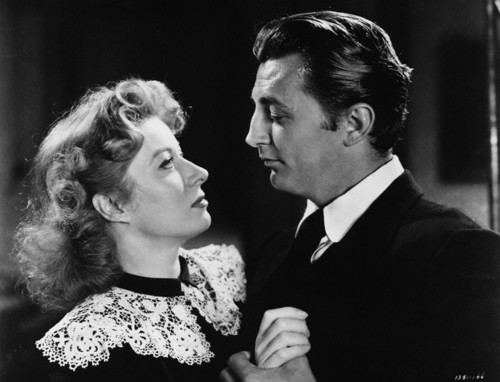
Garson and Mitchum

While the audience has their guard up and can sense the emotional instability of Jean, he gradually crosses the line from lonely to creepy, with Marise a little slow on the uptake.

The acting, disappointingly, isn't particularly note-worthy. We've all seen Garson and Mitchum in far more engrossing and challenging roles. Granted, both are gifted actors and make due with what little is given to them in the script -- but it just isn't enough to truly rise above the material. Buried deep beneath this half-wartime love story, half-psychological thriller, Desire Me has a better movie waiting to come out.

The cinematography from Joseph Ruttenberg is gorgeous, lending the film a foreboding sense of danger through his keen eye. His visuals, combined with a lack of soundtrack in the climactic finale, briefly helps Desire Me rise above its scattered script. Eyes meeting through the mist, voices echoing along the cliffs, gunshots ringing out in the night, Ruttenberg's work is stunning. His cinematography allows for a sense of consistency in a film that is a narrative mess.

Desire Me is one of those forgotten classic films that you catch on TV late one night and are reminded as to why it has been forgotten in the first place. While there are stylistic elements that are certainly impressive, Desire Me will ultimately leave you cold.

FINAL GRADE: C+