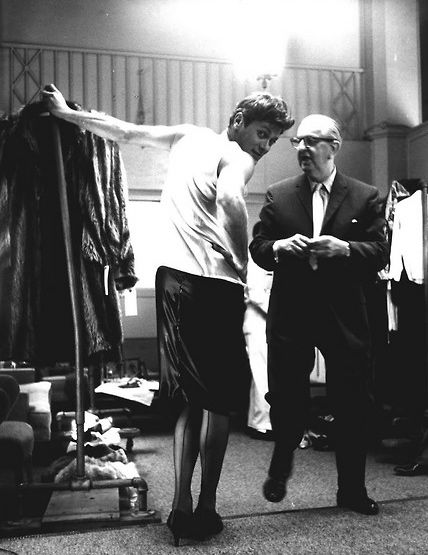
Jack Lemmon and Tony Curtis as Daphne and Josephine
Day 23: FAVOURITE COMEDY FILM
I've written about this 1959 classic a bunch of times already. My obsession with this film has continued, unabated, for more than a year now -- ever since I watched it twice in one week and wondered why it had taken me so long to watch it in the first place.
Sure, it may not constantly have laugh-out-loud moments and it may not be to everyone's personal tastes, but Some Like It Hot has one of the cleverest scripts to ever come out of Hollywood, thanks in large part to director Billy Wilder and co-screenplay writer I.A.L. Diamond. It's so ahead of its time it's unbelievable.
The film is an absolute farce, with a broad sense of humour that revolves around a simple plot involving two musicians who witness a Mob murder and go into hiding by dressing as women and joining an all-girl touring musical band. It has a manic, high-octane energy -- everything feels as though it's moving in fast forward. Devoid of any dull moments, Some Like It Hot is as intelligent as it is hilarious. The jokes are whip-smart, the social commentary is sharp and the starring cast of Jack Lemmon, Tony Curtis and Marilyn Monroe are all impossibly perfect in their respective roles. The most startling thing about the film is that, to this very day, it remains as fresh and relevant as it was in 1959.
Marilyn Monroe as Sugar.
How many films of the 1950s and early-1960s openly challenged traditional gender roles and sexuality the way Some Like It Hot did so effectively? The first time I watched it I was blown away by the fact that it even managed to bypass the rigid Hollywood Motion Picture Production Code censorship guidelines. With it's jokes about gender identity, sex and Jack Lemmon's character openly embracing and revelling in his new life as Daphne (even going so far as to accept a marriage proposal from the millionaire Osgood Fielding III), it's amazing that the film even went on to become a monster hit in 1959. Hollywood executives were left reeling, but the film remains a classic -- one of those genuinely superb films that actually deserves the laurels and praise of being labelled a 'comedy classic.'
One of my friends asked that I post some more bite-size quotes from the book (which I've almost completed).
* How Tony Curtis managed long hours on the set without taking washroom breaks: “I put my thinking cap on and built a funnel-and-hose thing. It went around my thigh, down the inner side of one leg, and was hidden inside the silk stocking that I was wearing. I didn’t have to stand up or sit down. It wasn’t all that comfortable, but it worked. I should have taken out a patent on it …One day Jack (Lemmon) caught me in the men’s room. I was adjusting the thing. 'What the fuck are you doing?' he asked. 'Never mind,' I answered. 'I’m inventing something.' I didn’t tell him because he might judge me. He was kind of conservative in an odd way." (p. 82)
* Billy Wilder and his perfectionism: “I remember the scene in Poliakoff’s office, the agency where Jack and I are scrounging for work. Jack got excited, and after finishing a speech with the line ‘Now you’re talking,’ he repeated the line. Billy froze. ‘That’s not how the speech reads,’ he said. Jack pleaded. It felt right to him to say the line twice. Billy walked over to Izzy (co-screenwriter I.A.L. Diamond), who was sitting a short distance away. They started talking in low tones. This went on for close to half an hour. He finally came back to us. ‘Okay, you can repeat it,’ he said solemnly." (p. 111)
* Marilyn Monroe once took 81 takes before nailing a scene which required her to speak only one simple line - 'Where's that bourbon?' - She directed her frustration at Billy Wilder: "Jack and I were like two bad little kids in school. We wanted to laugh out loud so badly, but we had to turn away and do it into our hands. It was fucking outrageous. Next Billy tried putting cue cards inside the drawers. Even that didn't help. But he had to get the shot. There was no way to cut around it. I wish I'd bet a thousand dollars on eighty takes. It took eighty-one. 'I swallowed my pride,' recalled Billy. 'If she showed up, she delivered, and if it took eighty takes, I lived with eighty takes, because the eighty-first was very good.' Cut. Print. Faint." (p. 167).
* Curtis always seemed to be in awe of Jack Lemmon: "I was delighted to have Jack as a costar. He could be theatrical without worrying if he was making a fool of himself. He was comfortable in his own skin. That giggle he did as Daphne wasn't just clever. It was brilliant. Jack didn't mention his personal life at work. We both came from a certain tradition. When you were on the job, you never discussed politics, religion, family or sex. It just wasn't done in those days. But when I saw him at Hollywood parties, he had a glass of whiskey in his hand and he was more forthcoming ...A lot of men who are gentle need to drink because they're embarrassed about not being cavemen. That's my theory, anyway." (p. 159)
++ I find this passage really interesting because, if you've read the book, it's yet another example of Curtis being literally in awe of Lemmon's ability as both a comedic actor and as a human being. Curtis rarely wrote about Lemmon in The Making of Some Like It Hot (he tended to focus more on Monroe and Wilder), but when he did mention Lemmon, it was always respectful and tasteful. Curtis denied being jealous of Lemmon's talent but I wonder how true that really was because of how he writes about Lemmon -- both praising him and also pushing him into the background in favour of Monroe and Wilder. One thing I think Curtis does convey really well is the simple fact that Jack Lemmon was a class act. And Hollywood doesn't make them like that anymore.
Curtis had a really simple, engaging style of writing. It's more conversational -- like he's narrating this high point in his film career directly onto the page.
There are those (film critics, celebrities and the general public) who label Curtis as an outright liar and paint him as an opportunistic man prone to exaggeration. Did he or did he not impregnate Marilyn Monroe? Did they really have a torrid, top secret romance? Curtis says yes, while others point out that Monroe isn't around to tell her side of the story. Nor is the film's director Billy Wilder or his co-star Jack Lemmon. Curtis wrote his book in 2009, many, many years after the deaths of Monroe, Lemmon and Wilder (and a year before his own).
Regardless, I take everything Curtis wrote with a grain of salt. I know to make sure I don't fall into any traps as I read The Making of Some Like It Hot. But damned if the man doesn't spin a great behind-the-scenes yarn. I'm a sucker for those largely unknown Hollywood dramas that often played out in between takes, I'm only 60 pages into the book, but here are some interesting (and likely true) tidbits in this gospel according to Curtis:
* He was once roommates with Marlon Brando for four months: "I respected him. But I wasn't interested in the Method. He was great because he was Marlon, not because of the Method. I thought it was phoney. Why complicate the job of acting? Memorize your lines. Learn the part. Find out what the director wants. Then show up on time and act. This idea of trying to remember when your sister stole your peanut butter sandwich so you can give an angry performance is bullshit. If you can't turn it on by yourself, you don't belong in front of the camera." (p.39)
++ An interesting commentary on the much respected Method acting technique (introduced by Brando), to say the least.
* Marilyn Monroe's intelligence: "Marilyn was not unintelligent. She was bright, perceptive and insightful -- but only about other people. When it came to herself, or to issues relating to herself, she didn't have a clue. She needed constant reassurance." (p.39)
* His first encounter with Marilyn: "We walked to my car and I opened the door for her. I got behind the wheel, drove out the gate, and turned left, heading for Hollywood. I angled the review mirror a little so I could see her face. To my surprise she winked at me. We laughed." (p.31)
* The first time he and Jack Lemmon walked in front of the cast and crew dressed as women: "I blushed under the makeup and let the actor in me take over. I launched into a little routine. I was coy. I was reluctant ...When Jack came out he did it in a big way. He was in character as Daphne. He flew out, twirling and pirouetting. He danced ...I just stared. How the fuck could he do that? I was envious, but it was the first and last time. I loved the guy." (p. 59)
This one wasn't as tough as I expected, given the love I have for Billy Wilder's 1959 comedy, Some Like It Hot.
A few runners-up: (1) "I am big! It's the pictures that got small."
(Sunset Blvd.) (2) "I have always depended on the kindness of strangers."
(A Streetcar Named Desire) (3) "Louis, I think this is the beginning of a beautiful friendship"
(Casablanca) (4) The "patron saint of mediocrity" speech.
(Amadeus) (5) "You keep your friends close, but your enemies closer."
(The Godfather Part II)
It all comes back, though, to the final scene (the final few seconds, to be exact) of Some Like It Hot. You've got Jack Lemmon, one of the masters of exaggerated facial reactions, dressed as a woman. On a speedboat. With a millionaire named Osgood Fielding III (Joe E. Brown). Osgood is the one who utters the famous line: "Well, nobody's perfect."
Lemmon plays Jerry, a man on the run with his friend, Joe (Tony Curtis), after the two witness a mob murder. Lemmon's Jerry soon becomes Daphne, as the two friends decide to disguise themselves as women as a ruse to throw off the mobsters. While Curtis is off flirting with Marilyn Monroe's Sugar, Lemmon's subplot in the film involves being wooed (and proposed to) by Osgood. The two develop a charming bond (thanks in large part to the great chemistry between Lemmon and Brown), all of which culminates in a simple exchange at the very end of the film when "Daphne" reveals she's really a man.
Jerry: "Osgood, I'm gonna level with you. We can't get married at all." Osgood: "Why not?" Jerry: "Well, in the first place, I'm not a natural blonde." Osgood: "Doesn't matter." Jerry: "I smoke! I smoke all the time!" Osgood: "I don't care." Jerry: "Well, I have a terrible past. For three years now, I've been living with a saxophone player." Osgood: "I forgive you." Jerry: "I can never have children!" Osgood: "We can adopt some." Jerry: "But you don't understand, Osgood!" *Jerry pulls off wig* Jerry: "I'm a man!" Osgood:"Well, nobody's perfect."
Why I Love This Quote: It's arguably one of the best fade-out lines in film history. Both actors are perfect in this scene, especially with Lemmon's growing exasperation as he gently tries to break his engagement to Brown without revealing the fact that he's a man. Brown's nonchalance and unconditional love is unwavering with each new shocking revelation. What is so incredible about the scene (and the Daphne/Osgood relationship, in general) is the suggestion that Jerry (as Daphne) was happy in his new role as a woman. This is evident in the scenes where Daphne is being wooed by her rich millionaire. Jerry, as Daphne, is thoroughly enjoying the attention. A later conversation between Jerry and Joe reveals that Jerry has accepted Osgood's marriage proposal and is smitten with his new beau and his big, shiny diamond ring. When Joe asks him why he'd want to marry a man, Jerry responds: "For security!" A movie that started out about two men evading gangsters turned into something much more interesting: Jerry embracing his new feminine way of life.
Interesting trivia: Co-screenwriter I.A.L. Diamond wrote the line the night before the scene was shot.
It made me realize how many of the classic actors of the 1950s and 1960s are slowly disappearing. The death of Curtis, at the age of 85, is much like the loss of Paul Newman last year: it reminds us that the "golden days" of Hollywood are rapidly disappearing with the deaths of its legends. Their old film stories and anecdotes are going with them.
Curtis was famous for openly sharing his experiences as an actor and a celebrity. Whether you believed his stories or not (and there are many who accuse him of being an outright liar), he acted as though he were an open book. Curtis wrote books on the subject of celebrity and filmmaking (most recently, 2009's The Making of Some Like It Hot: My Memories of Marilyn Monroe and the Classic American Movie, something I can't wait to read once it comes out in paperback). He fanned the flames of gossip when he claimed that Monroe miscarried their child (the product of a brief fling) soon after filming wrapped on the 1959 film. He was famously married to Janet Leigh and is father to actress Jamie Lee Curtis. He essentially put all his cards on the table, regardless of whether you liked him or not. He was a classy actor, even when sharing the most explicit details of his life in Hollywood.
I'm kind of ashamed to admit I've only seen three films in his extensive resume. The Defiant Ones, which I saw on TCM a good five years ago (I'm due for a re-watch), Spartacus and one of my all-time favourite films, Some Like It Hot. I saw the latter film for the first time only last year, when I bought it on a whim. It really lives up to its honour of the Best American Comedy (bestowed by the American Film Institute). As Joe/Josephine, Curtis is paired with two wonderful co-stars in Jack Lemmon and Marilyn Monroe. When I first bought the film, I watched it twice in one week (no lie!) and a total of three times in that first month. While every aspect of the film is wonderful, Curtis' performance is one of the highlights.
Curtis was also a talented painter and was technologically savvy. He knew how to communicate with fans in the age of the Internet. You can check out his official website (run by Curtis Enterprises). He still offered to mail autographs to fans (a snail mail address is included on his website) and all of his most recent paintings were displayed in his online art gallery. Curtis was also the founder of Shiloh Horse Rescue and Sanctuary, a non-profit organization (started in 2003) which rehabilitates homeless and abused horses. His website claims that it has saved the lives or more than 500 horses.
His memorial service (according to his blog, run by Shiloh Horse Rescue and Sanctuary) is on October 4th and will be open to the public to allow both family and fans to pay their respects. I was really surprised by this ...it's so rare for an open memorial service for a celebrity).
Regardless of your opinion of Curtis, he was a charismatic screen legend and, up until now, one of the few who were left from an era long gone. Hollywood is now short one more star.