Ted (2012)
Written & Directed by: Seth MacFarlane
Starring: Mark Wahlberg, Mila Kunis and (the voice of) Seth MacFarlane
Given the enduring popularity of TV's Family Guy and its creator, Seth MacFarlane, it was inevitable that the comedian would eventually make the leap from the tube to the big screen. With Ted, MacFarlane writes and directs his debut feature with mixed results.
When John Bennett (Mark Wahlberg) was a child he made a Christmas wish that his favourite teddy bear would come to life and be his friend in real life. Easily the loneliest boy on the block, John is thrilled when his wish comes true. Now in his mid-30s, John is a slacker who spends his days smoking weed, watching Flash Gordon reruns and trash-talking with his foul-mouthed bear, Ted (voiced by Seth MacFarlane). Even John's incredibly patient girlfriend, Lori (Mila Kunis), has reached her limit and wants him to make a choice: Her ...or the teddy bear.
Fans of MacFarlane will undoubtedly leave the theatre satisfied -- the flick is as crass and vulgar as any Family Guy episode, only times a hundred. Ted may look like a cuddly children's toy but he has no filter, spewing out raunchy one-liners and thumbing his nose at political correctness. While some jokes hit their mark, there are those that fall far short of the target -- behaving badly doesn't always equal laughs.
Those uninitiated in MacFarlane's particular brand of humour are still bound to find some moments amusing -- although the majority of the best lines can be found in the movie's trailer. While Ted does have its laugh-out-loud moments, for the most part it's a bunch of haphazard comedy vignettes, centred around a talking teddy bear -- a narrative that eventually wears out its welcome. It's thin premise only carries the flick so far, as evidenced by a random, tacked-on, unfunny kidnapping subplot involving a creepy Giovanni Ribisi in the latter half of the film that threatens to collapse the whole flick.
If there's anything keeping Ted afloat, it's the effortlessly energetic charm of Mark Wahlberg. There's something to be said for watching an actor have a great time in a particular role. Ted is a welcome departure for the action flick vet who knows how to sell a one-liner and generate his own laughs -- with or without the help of his little bear friend. Using his natural Boston accent, Wahlberg nearly steals the movie right from under Ted's fuzzy feet.
However, in the end, Ted tries too hard to shock the laughs out of its audience with its excessive (and ultimately redundant) attacks on everything from bullied,overweight children and the gay community to "kid cancer." By the end, you may be a little worn thin from the constant barrage of rapid-fire pop culture references.
Perhaps Ted would have worked with a shorter running time (or half hour television episodes?). And, while it does have its fair share of laughs, this bear does better in small doses.
FINAL GRADE: C+
Tuesday, July 17, 2012
Thursday, July 12, 2012
Classic Film Review: The Palm Beach Story
The Palm Beach Story (1942)
Written & Directed by: Preston Sturges
Starring: Claudette Colbert, Joel McCrea, Rudy Vallee and Mary Astor
"You have no idea what a long-legged woman can do without doing anything."
Critics continue to hail The Palm Beach Story as a classic of the screwball comedy genre, one of its crowning achievements. The film is indeed an enjoyable diversion, albeit one that occasionally suffers from one too many scenes that distracts from the four main characters at the centre of the plot.
After five years in a seemingly happy and stable marriage, Gerry (Claudette Colbert) up and leaves her penniless husband, Tom (Joel McCrea), a struggling architect who just can't seem to make ends meet. Gerry flees to Florida for a quickie divorce, whereupon she meets the charmingly gullible John D. Hackensacker III (Rudy Vallee) and his sister, Princess Centimillia (Mary Astor). When Gerry discovers that the siblings are multi-millionaires she immediately concocts a plan that will help funnel some of their wealth into her soon-to-be-ex-husband's bank account, saving them both from a life of poverty. When a disgruntled Tom shows up looking for his wife, Gerry convinces him to play along as her brother so she can get closer to John and carry out the plan.
Writer and director Preston Sturges crafted an easy, breezy farce with cleverly witty and engaging dialogue that centres about the pursuit of wealth -- and the consequences that come with it. However, Palm Beach Story often gets a little lost in its own zaniness. The film starts off on a rocky note with an unnecessarily drawn-out set-up for Gerry and the millionaire John to meet on a train ride to Florida. Their engaging banter is too often broken up a gun club aboard the train who insist on shooting the place up after having one too many drinks. At this point the film nearly topples under the strain of its own wackiness.
However, once Gerry and John exit the train, the narrative settles into itself -- and it's a combination of Sturges' rapid-fire dialogue and his exceptional casting choices that help steer The Palm Beach Story on course.
As Gerry, Claudette Colbert reminds audiences of why they were so charmed by her in the earlier screwball classic, It Happened One Night (1934). The beautiful, doe-eyed actress had a knack for finding hilarity in even the smallest of gestures and its because of her talent that Gerry is such an immensely entertaining character.
While Joel McCrea plays straight-man Tom perhaps a little too straight (never quite loosening up), Rudy Vallee nearly runs away with the film as the charismatic and socially awkward millionaire John D. Hackensacker III. Under the assumption that Colbert's Gerry is leaving her big, strong husband because of abuse, Vallee perfectly delivers one of Sturges' best lines of dialogue: "That's one of the tragedies of this life, that the men who are most in need of a beating up are always enormous." He underplays the role to perfection, his John creating a perfect balance between himself and the wild antics of the frenzied Gerry.
For the most part, The Palm Beach Story holds up well, delivering charming performances and genuine laughs. Despite a couple of missteps in the first half of the film, it's an amusing romp led by the vastly different, yet equally entertaining, performances of Colbert and Vallee.
FINAL GRADE: B+
Written & Directed by: Preston Sturges
Starring: Claudette Colbert, Joel McCrea, Rudy Vallee and Mary Astor
"You have no idea what a long-legged woman can do without doing anything."
Critics continue to hail The Palm Beach Story as a classic of the screwball comedy genre, one of its crowning achievements. The film is indeed an enjoyable diversion, albeit one that occasionally suffers from one too many scenes that distracts from the four main characters at the centre of the plot.
After five years in a seemingly happy and stable marriage, Gerry (Claudette Colbert) up and leaves her penniless husband, Tom (Joel McCrea), a struggling architect who just can't seem to make ends meet. Gerry flees to Florida for a quickie divorce, whereupon she meets the charmingly gullible John D. Hackensacker III (Rudy Vallee) and his sister, Princess Centimillia (Mary Astor). When Gerry discovers that the siblings are multi-millionaires she immediately concocts a plan that will help funnel some of their wealth into her soon-to-be-ex-husband's bank account, saving them both from a life of poverty. When a disgruntled Tom shows up looking for his wife, Gerry convinces him to play along as her brother so she can get closer to John and carry out the plan.
Writer and director Preston Sturges crafted an easy, breezy farce with cleverly witty and engaging dialogue that centres about the pursuit of wealth -- and the consequences that come with it. However, Palm Beach Story often gets a little lost in its own zaniness. The film starts off on a rocky note with an unnecessarily drawn-out set-up for Gerry and the millionaire John to meet on a train ride to Florida. Their engaging banter is too often broken up a gun club aboard the train who insist on shooting the place up after having one too many drinks. At this point the film nearly topples under the strain of its own wackiness.
However, once Gerry and John exit the train, the narrative settles into itself -- and it's a combination of Sturges' rapid-fire dialogue and his exceptional casting choices that help steer The Palm Beach Story on course.
![]() |
| Joel McCrae, Rudy Vallee and Claudette Colbert |
While Joel McCrea plays straight-man Tom perhaps a little too straight (never quite loosening up), Rudy Vallee nearly runs away with the film as the charismatic and socially awkward millionaire John D. Hackensacker III. Under the assumption that Colbert's Gerry is leaving her big, strong husband because of abuse, Vallee perfectly delivers one of Sturges' best lines of dialogue: "That's one of the tragedies of this life, that the men who are most in need of a beating up are always enormous." He underplays the role to perfection, his John creating a perfect balance between himself and the wild antics of the frenzied Gerry.
For the most part, The Palm Beach Story holds up well, delivering charming performances and genuine laughs. Despite a couple of missteps in the first half of the film, it's an amusing romp led by the vastly different, yet equally entertaining, performances of Colbert and Vallee.
FINAL GRADE: B+
Sunday, July 8, 2012
Movie Review: Take This Waltz
![]() |
| Luke Kirby and Michelle Williams |
Written & Directed by: Sarah Polley
Starring: Michelle Williams, Seth Rogen and Luke Kirby
"Life has a gap in it. It just does. You don't go crazy trying to fill it."
Back in 2006 Sarah Polley made a name for herself as a promising young writer and director on the indie film scene. With her directorial debut, Away from Her, Polley garnered the kind of attention few young artists even dream of -- the end result being an Oscar nomination for Best Adapted Screenplay. Now, with Take this Waltz, Polley delves even deeper into the nature of relationships in all their complex highs and lows.
Freelance writer Margot (Michelle Williams) is a (mostly) happily married wife to cookbook author, Lou (Seth Rogen). Despite the occasional spat, the couple appear content in their relationship -- that is until Margot meets her handsome artist neighbour, Daniel (Luke Kirby). Margot starts to feel more alive than she has in years, sneaking out to meet up with Daniel for late-night swims, afternoon drinks or just everyday trips around Toronto. Their gradually evolving attraction to one another -- and Margot's ever-present guilt at the thought of cheating on her husband -- is at the centre of Polley's thought-provoking sophomore release.
Films rarely allow audiences to glimpse the most intimate moments of a relationship and Polley is a master at building characterization through even the smallest suggestions. Margot and Lou speak in their own language and create dozens of inside jokes -- small, everyday moments that help solidify the foundation of a relationship. Polley takes risks, creating flawed characters that often border on unlikeable. Her willingness to portray very human decisions -- even the selfish ones -- speaks volumes about her ability to see every aspect of a personality.
As one character observes in the film, "new things become old." It's a part of human nature to desire something new and exciting. We often shy away from routine. Or, like Margot, we fear the "in between" and not knowing if something better will come along. However, Margot's inability to recognize the truth in that simple statement, and to not be so afraid of it, is what ultimately leads to her unravelling.
With regards to the performances, no one in her generation plays complex and conflicted women better than Williams. Whether you find Margot a sympathetic figure or not is irrelevant -- Williams portrays her as both a world-weary adult and free-spirit who just wants to openly embrace the excitement of new love. She gives a lovely, honest performance that perfectly compliments Polley's vision.
As Lou, Rogen veers away from his usual comedic roles and gives a surprisingly touching performance as a man slowly coming to terms with the fact that his marriage is deteriorating. At first glance, Rogen and Williams may appear to be an unlikely couple, but they generate chemistry through the small, intimate flourishes they add to their characters' relationship. And, finally, as Daniel, Kirby gives off a soulful, hopeless romantic vibe -- a nice guy who has been burned in the past when it comes to love.
While Take this Waltz focuses on the finer details of everyday life, creating an intimate portrait of love gained and lost, its only major stumble is in its overlong running time and multiple false endings.
But, for those looking for a reprieve from all the summer blockbusters, Take this Waltz is a quiet indie that will keep you thinking.
FINAL GRADE:B+
Thursday, July 5, 2012
Classic Film Review: My Man Godfrey
My Man Godfrey (1936)
Directed by: Gregory La Cava
Starring: William Powell and Carole Lombard
With the emergence of the "screwball comedy" in the 1930s, Hollywood discovered a sure-fire way to lift the spirits of an American populace struggling to survive the Depression. Audiences sought a reprieve from their daily hardships in the form of beautiful celebrities who had an effortless ability to make them laugh and transport them to another time and place.
It has been more than 75 years since My Man Godfrey was first released, yet it's the sign of a story well told when it manages to hold up for generations of new fans.
Working from a script based on the novel by Eric Hatch, director Gregory La Cava crafted a comedic masterpiece that manages to be both a sharp social commentary on the class system of the 1930s and a laugh-out-loud farcical romp.
When spoiled socialite Irene Bullock (Carole Lombard) crosses paths with Godfrey (William Powell), a "forgotten man" living in a city dump, she convinces him to accompany her a party teeming with the creme de la creme of New York society. Her reason? To win a scavenger hunt in which one of the items listed is to return with a homeless person. Irene is instantly infatuated with the mysterious Godfrey and convinces her parents (Eugene Pallette and Alice Brady) to take him in as the new family butler -- much to her elder sister Cornelia's (Gail Patrick) distaste. Irene takes Godfrey under her wing, referring to him as her "protege", much in the same way that her own mother addresses Carlo (Mischa Auer), a young Italian man she keeps around the house for her amusement. Godfrey is forced to endure the inane antics of the Bullock family -- the most alarming issue being the shocking advances made by Irene, who seeks to woo the butler into marriage.
My Man Godfrey is like a fine wine -- it's aged remarkably well for a film so firmly ingrained in 1930s society. You laugh along with its implausible situations and clever wordplay while considering its thoughtful commentary on social order. Even its remarkable cinematography has transferred well, with Ted Tetzlaff's rich visuals jumping off the screen.
However, it's savvy dialogue and physical comedy could have easily fallen flat in less capable hands. Luckily for audiences, La Cava's ingenious decision to cast screwball genre stalwart Carole Lombard and the charismatic William Powell paid off in spades. The fact that the two actors were once briefly married in real life prior to filming made the dynamic all the more electric.
Powell's razor-sharp delivery and straight-man comedic chops provides perfect fodder for Lombard's whimsical, slightly neurotic performance. Watching them engage in witty repartee and innuendos is the reason behind My Man Godfrey's designation as one of the greatest screwball comedies of all time. Lombard, in particular, shines in her role. In the hands of a lesser actress, the role of Irene would have come off as nothing more than a simpering brat unworthy of audience sympathy. Instead, you find yourself rooting for her happiness, despite her flaws and regardless of her obliviousness to the world around her.
The supporting cast fares just as well as the leads, specifically the maniacal frenzy of Alice Brady as Mrs. Bullock and the amusingly over-dramatic antics of Mischa Auer in the scene-stealing role of Carlo.
My Man Godfrey is pure unadulterated fun -- witty escapism at its finest. If only all films were this good.
FINAL GRADE: A+
Directed by: Gregory La Cava
Starring: William Powell and Carole Lombard
With the emergence of the "screwball comedy" in the 1930s, Hollywood discovered a sure-fire way to lift the spirits of an American populace struggling to survive the Depression. Audiences sought a reprieve from their daily hardships in the form of beautiful celebrities who had an effortless ability to make them laugh and transport them to another time and place.
It has been more than 75 years since My Man Godfrey was first released, yet it's the sign of a story well told when it manages to hold up for generations of new fans.
Working from a script based on the novel by Eric Hatch, director Gregory La Cava crafted a comedic masterpiece that manages to be both a sharp social commentary on the class system of the 1930s and a laugh-out-loud farcical romp.
When spoiled socialite Irene Bullock (Carole Lombard) crosses paths with Godfrey (William Powell), a "forgotten man" living in a city dump, she convinces him to accompany her a party teeming with the creme de la creme of New York society. Her reason? To win a scavenger hunt in which one of the items listed is to return with a homeless person. Irene is instantly infatuated with the mysterious Godfrey and convinces her parents (Eugene Pallette and Alice Brady) to take him in as the new family butler -- much to her elder sister Cornelia's (Gail Patrick) distaste. Irene takes Godfrey under her wing, referring to him as her "protege", much in the same way that her own mother addresses Carlo (Mischa Auer), a young Italian man she keeps around the house for her amusement. Godfrey is forced to endure the inane antics of the Bullock family -- the most alarming issue being the shocking advances made by Irene, who seeks to woo the butler into marriage.
My Man Godfrey is like a fine wine -- it's aged remarkably well for a film so firmly ingrained in 1930s society. You laugh along with its implausible situations and clever wordplay while considering its thoughtful commentary on social order. Even its remarkable cinematography has transferred well, with Ted Tetzlaff's rich visuals jumping off the screen.
![]() |
| Carole Lombard and William Powell |
Powell's razor-sharp delivery and straight-man comedic chops provides perfect fodder for Lombard's whimsical, slightly neurotic performance. Watching them engage in witty repartee and innuendos is the reason behind My Man Godfrey's designation as one of the greatest screwball comedies of all time. Lombard, in particular, shines in her role. In the hands of a lesser actress, the role of Irene would have come off as nothing more than a simpering brat unworthy of audience sympathy. Instead, you find yourself rooting for her happiness, despite her flaws and regardless of her obliviousness to the world around her.
The supporting cast fares just as well as the leads, specifically the maniacal frenzy of Alice Brady as Mrs. Bullock and the amusingly over-dramatic antics of Mischa Auer in the scene-stealing role of Carlo.
My Man Godfrey is pure unadulterated fun -- witty escapism at its finest. If only all films were this good.
FINAL GRADE: A+
Tuesday, June 26, 2012
Movie Review: Abraham Lincoln: Vampire Hunter
Abraham Lincoln: Vampire Hunter (2012)
Directed by: Timur Bekmambetov
Based on the Novel by: Seth Grahame-Smith
Starring: Benjamin Walker, Dominic Cooper, Rufus Sewell and Mary Elizabeth Winstead
Abraham Lincoln, a vampire hunter? Regardless of whether or not you count yourself as a history buff, the mere thought of America's 16th president killing supernatural bloodsuckers is an example of pulp fantasy history at its finest. It's just a shame that the CGI-laden Abraham Lincoln: Vampire Hunter doesn't live up to the entertaining potential of its title.
Based on the novel by Seth Grahame-Smith (who also wrote the screenplay) and directed by Timur Bekmambetov, Vampire Hunter is never given the chance to let loose and have fun with the subject matter. Author and director make the curious decision of taking the tale seriously, the result being a slow slog through what ultimately amounts to nothing more than a fictional biography of a respected historical figure.
In the prologue, young Abe witnesses the death of his beloved mother at the hands of a slave-owning vampire (Marton Csokas). Years later, Abraham (Benjamin Walker) teams up with Henry Sturgess (Dominic Cooper), a man with his own ax to grind when it comes to vampires.
Henry informs Abe that there's been a rampant infestation of bloodsuckers since the Europeans emigrated to North America. The vampires, in particular, were attracted to the Deep South, where they fed off the bodies of African slaves and gathered under the rule of their 5,000-year-old leader, Adam (Rufus Sewell).
Unaffected by sunlight (which they block out with the protection of sunglasses anyway just to err on the side of caution) the vampire race suffers from a severe aversion to silver -- something that Abe takes advantage of by wielding a silver-edged ax. Vampire Hunter (very) loosely follows the basic outline of Lincoln's life, from his time spent as a shoekeepers assistant to meeting his future wife, Mary Todd (Mary Elizabeth Winstead), to his political rivalry with Stephen A. Douglas (Alan Tudyk).
It's the thought of Adam and his undead henchmen wreaking havoc across the United States that ultimately inspires Abe to run for office. The flick posits that he didn't necessarily sign the Emancipation Proclamation to abolish slavery per se -- he did it moreso out of a desperate attempt to quell the tide of vampires controlling the United States.
All of this sounds as though it would make for an instant cult classic. Alas, instead of a wildly entertaining and clever piece of tongue-in-cheek revisionist history, Vampire Hunter is as dull and lifeless as its nocturnal villains. If nothing else, it should be pure, unadulterated camp. Instead it's saddled with clunky dialogue and randomly inserted action sequences that try desperately to hold viewer interest. Only Walker and Sewell seem to be having some fun in their respective roles as Lincoln and Adam, yet even they can't rise above the plodding material.
Anyone looking for laughs or the cheap thrills that usually come with B-movie territory will be sorely disappointed. Vampire Hunter promises much and delivers little.
Why so serious, Abe?
FINAL GRADE: C+
Directed by: Timur Bekmambetov
Based on the Novel by: Seth Grahame-Smith
Starring: Benjamin Walker, Dominic Cooper, Rufus Sewell and Mary Elizabeth Winstead
Abraham Lincoln, a vampire hunter? Regardless of whether or not you count yourself as a history buff, the mere thought of America's 16th president killing supernatural bloodsuckers is an example of pulp fantasy history at its finest. It's just a shame that the CGI-laden Abraham Lincoln: Vampire Hunter doesn't live up to the entertaining potential of its title.
Based on the novel by Seth Grahame-Smith (who also wrote the screenplay) and directed by Timur Bekmambetov, Vampire Hunter is never given the chance to let loose and have fun with the subject matter. Author and director make the curious decision of taking the tale seriously, the result being a slow slog through what ultimately amounts to nothing more than a fictional biography of a respected historical figure.
In the prologue, young Abe witnesses the death of his beloved mother at the hands of a slave-owning vampire (Marton Csokas). Years later, Abraham (Benjamin Walker) teams up with Henry Sturgess (Dominic Cooper), a man with his own ax to grind when it comes to vampires.
Henry informs Abe that there's been a rampant infestation of bloodsuckers since the Europeans emigrated to North America. The vampires, in particular, were attracted to the Deep South, where they fed off the bodies of African slaves and gathered under the rule of their 5,000-year-old leader, Adam (Rufus Sewell).
![]() |
| Erin Wesson and Benjamin Walker |
It's the thought of Adam and his undead henchmen wreaking havoc across the United States that ultimately inspires Abe to run for office. The flick posits that he didn't necessarily sign the Emancipation Proclamation to abolish slavery per se -- he did it moreso out of a desperate attempt to quell the tide of vampires controlling the United States.
All of this sounds as though it would make for an instant cult classic. Alas, instead of a wildly entertaining and clever piece of tongue-in-cheek revisionist history, Vampire Hunter is as dull and lifeless as its nocturnal villains. If nothing else, it should be pure, unadulterated camp. Instead it's saddled with clunky dialogue and randomly inserted action sequences that try desperately to hold viewer interest. Only Walker and Sewell seem to be having some fun in their respective roles as Lincoln and Adam, yet even they can't rise above the plodding material.
Anyone looking for laughs or the cheap thrills that usually come with B-movie territory will be sorely disappointed. Vampire Hunter promises much and delivers little.
Why so serious, Abe?
FINAL GRADE: C+
Thursday, June 21, 2012
Movie Review: Brave
Brave (2012)
Directed by: Mark Andrews and Brenda Chapman
Starring: Kelly Macdonald, Billy Connolly and Emma Thompson
Since Pixar's debut with Toy Story in 1995, the studio has been at the forefront of quality family entertainment. Setting a new standard of excellence that appeals to both kids and their parents, Pixar forced other animation production companies to sit up and take notice. With a team of writers and directors with a keen understanding into what draws in audiences of all ages, Pixar has an unmatched ability to make you both laugh and cry.
With only one misstep in 12 features (Cars 2), the studio seems poised for another instant classic with the release of Brave, setting out to do something it had never done before -- centre one of its films around a plucky heroine. It's just a shame that the film doesn't quite live up to expectations.
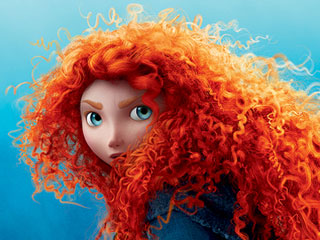
Princess Merida (Kelly Macdonald) is a strong-willed Scottish teen whose tongue is as sharp as her archery skills are exact. With a tangle of the most beautiful red hair you'll ever see, Merida resists the attempts of her parents, King Fergus (Billy Connolly) and Queen Elinor (Emma Thompson), to see her wed to a rival clansman to keep the peace. Shirking her royal duties, Merida enlists the help of a witch (Julie Walters) in an attempt to change her fate. However, in doing so, Merida unwittingly unleashes a curse that could potentially tear her family -- and the entire kingdom -- apart.
Brave is Pixar's most visually stunning film; arguably their best since Finding Nemo. The colours are so rich and vivid you can see every inch of their textured details, from Merida's wisps of red hair to the beautiful Scottish scenery. Even the unnecessary inclusion of 3D doesn't affect the overall beauty of this film. Every single colours pops.
Credit is also due to the writers for not doing the obvious in pairing Merida up with a young prince. She struggles for her freedom and her actions are thus rewarded. It was a wise decision considering that, above all, this is a story about the often tumultuous relationships between mothers and their daughters.
However, Brave doesn't quite live up the standard set by Pixar predecessors, falling well short of classics like Finding Nemo and WALL-E. It's thin premise contains few jokes or rousing action sequences, leaving the middle of the film feeling a little aimless. It's a simple, straight-forward narrative and that may ultimately be the reason it doesn't truly excel. Although there are moments of drama and a few touching family sequences, Brave lacks scenes with the emotional wallop of the opening 10 minutes of UP or the finale of Toy Story 3.
We can only hope that, now that Pixar has broken new ground with a predominantly female-centred story (one devoid of a male love interest), that others will follow suit. Brave is still a warm and fuzzy family outing, it just feels a little lacking.
FINAL GRADE: B+
Labels:
disney,
emma thompson,
kelly macdonald,
movie review 2012,
pixar
Sunday, June 17, 2012
Movie Review: Danny Boyle's Frankenstein
Danny Boyle's Frankenstein (2011)
Directed by: Danny Boyle
Starring: Benedict Cumberbatch and Jonny Lee Miller
I reviewed this film for Next Projection.
Push aside all thoughts of Boris Karloff, Robert DeNiro or
even Peter Boyle. Last year, Oscar-winning director Danny Boyle created a sharp,
mostly faithful retelling of the classic novel for London’s National Theatre that
was eventually filmed and screened for audiences around the world.
Working with a script from Nick Dear, Boyle returns to his
stage roots with his take on Mary Shelley’s 1818 Gothic masterpiece, Frankenstein. In a pre-show
behind-the-scenes look at the dress rehearsals, Boyle reveals that he took on
this ambitious production in an attempt to tell the story almost solely from
the Creature’s point of view – a risky venture considering the first half of
the play has very little dialogue as the Creature grunts and moans his way to
some semblance of humanity.
As a result, we see smaller, poignant moments that build on
the Creature’s characterization, such as his obvious delight at the sight of
the sunrise or how the thought of the moon makes him feel solitary. While
cutting out the first portion of Shelley’s novel may be jarring to some of her
fans, Boyle and Dear manage to narrow the focus and create a tighter narrative
structure that rearranges certain pivotal events while still remaining loyal to
the original text.
Right from the stunning opening scene, where a naked
Creature emerges from the womb-like contraption in which he was created,
Boyle’s Frankenstein holds our attention
for more than 10 minutes as we lay witness to the Creature’s first fumbling
steps. Without the additional narrative exposition of how he came to be, we are
thrust right into the Creature’s story the very same way he is suddenly thrust into
life.
The sparse sets leaves more room for the actors to breath
and the very presence of Benedict Cumberbatch and Jonny Lee Miller’s
performances fill the stage (and screen).
Miller perfectly fills the shoes of the arrogant Victor
Frankenstein, his assured answers eventually giving way to his haunted inner
torment and indecision over whether or not he could muster the courage to
destroy his own creation. Just when you may start to feel a twinge of sympathy,
he brushes away any thought of the sort with his cold conceit. He’s a
tragically flawed figure who hastily decided to play God, only to be humbled by
the fact that his own creation had to teach him about what it means to love.
![]() |
| Cumberbatch as the Creature and Miller as Frankenstein |
In the more difficult role of the two, Benedict Cumberbatch
is simply astonishing – completely inhabiting the character of the Creature.
It’s a fearless performance. As Cumberbatch revealed in the pre-show
behind-the-scenes interview, he studied the movements of accident victims who
were learning to walk again. As a result, you feel the Creature’s frustration
as he learns to walk for the first time, along with his desperation to
communicate with words and his all-encompassing desire to experience love. Both
Cumberbatch’s performance and Dear’s script make the Creature more than just a
pile of contorting limbs – he’s a full-blown intellectual, a man who can recite
Milton’s Paradise Lost by heart and
muses over what it really means to love. It is mankind that shows him evil and
teaches him about hate and the death of one’s soul, making the scenes where the
Creature euphorically tastes his first meal and feels his first rainfall all
the more bittersweet.
Cumberbatch and Miller play well off one another and their
shared scenes are some of the play’s highlights. Both men recently won Best
Actor at the Olivier Awards, handed out by the Society of London Theatre.
The rest of the supporting cast doesn’t fare as well in
underwritten roles, with the exception of Karl Johnson (TVs Rome) in the role of the blind cottager
that kindly takes the Creature in and provides him with an education.
In the final scene, as the Creature forces Frankenstein into
a game of cat and mouse across the North Pole, both of their utter desolation
is keenly felt – Frankenstein’s for his inability to overcome his pride and
destroy his creation and the Creature’s for his failure to find someone to love
him.
The two are destined to share their final days together as
Boyle’s play hauntingly comes to a close with the image of their worn frames
wandering away through the cold mists.
It's an
extraordinary piece of theatre, led by two spectacular lead performances, that makes
Danny Boyle’s Frankenstein an
absolute must-see.
Note: Cumberbatch and Miller alternated roles throughout the London run. Both options are available to view on this international cinema tour.
FINAL GRADE: A+
Subscribe to:
Posts (Atom)