Tuesday, March 26, 2013

Classic Film Review: Desire Me

Desire Me (1947)
Directed by: No director's credit
Starring: Greer Garson, Richard Hart and Robert Mitchum

It's pretty safe to say that, well before the end of production on Desire Me, no one wanted to have anything to do with this oft-overlooked picture.

The specialty channel TCM aired the film last week, with host Robert Osborne detailing the multiple cast changes, script rewrites and revolving door of high-profile directors that all culminated in the film's ultimate plummet at the box office. Few remember the film today. This is not the picture that Greer Garson or Robert Mitchum are remembered for, thankfully.

In fact, the most intriguing thing about Desire Me is the fact that it was the first MGM film to be released without a director's name attached. Jack Conway, George Cukor, Mervyn LeRoy and Victor Saville all took a stab at helming the project, but ultimately left for a myriad of reasons -- namely the lack of artistic freedom and Garson's allegedly difficult personality on set.

It was LeRoy who finished the picture in the end, however, none of the directors wanted their names attached to the film so the studio went ahead and released it without crediting anyone.

Desire Me begins with an isolated house set upon the cliffs in Brittany. With a setting more suited to a film adaptation of Wuthering Heights, we discover that it belongs to Marise Aubert (Garson), a woman who is led to believe that her husband, Paul (Mitchum), has died in the field during the Second World War. When a man appears by the name of Jean Renaud (Richard Hart) he claims that he was her husband's closest companion during the war and that he witnessed Paul's death. Marise finds herself drawn to this personable stranger and sets out to lead a life with him as though he were a replacement for her dead husband. Marise and Jean's friendship is frowned upon by the gossipy villagers -- how could two unmarried strangers live together under one roof? As we learn via flashback, Jean is more than content with this living situation, having fallen in love with Marise based on a photo of her and Paul's stories about his loving wife.

As Jean himself claims in one particularly eerie moment: "I wanted to know what it was like to come home to my own house. My own wife."
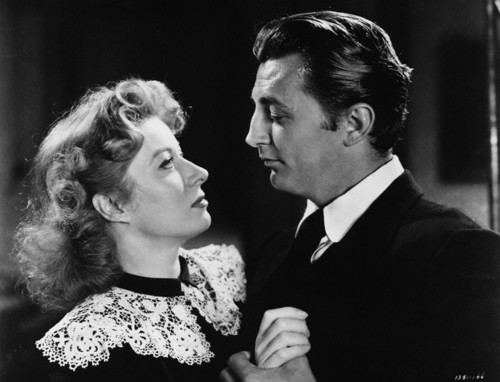
Garson and Mitchum

While the audience has their guard up and can sense the emotional instability of Jean, he gradually crosses the line from lonely to creepy, with Marise a little slow on the uptake.

The acting, disappointingly, isn't particularly note-worthy. We've all seen Garson and Mitchum in far more engrossing and challenging roles. Granted, both are gifted actors and make due with what little is given to them in the script -- but it just isn't enough to truly rise above the material. Buried deep beneath this half-wartime love story, half-psychological thriller, Desire Me has a better movie waiting to come out.

The cinematography from Joseph Ruttenberg is gorgeous, lending the film a foreboding sense of danger through his keen eye. His visuals, combined with a lack of soundtrack in the climactic finale, briefly helps Desire Me rise above its scattered script. Eyes meeting through the mist, voices echoing along the cliffs, gunshots ringing out in the night, Ruttenberg's work is stunning. His cinematography allows for a sense of consistency in a film that is a narrative mess.

Desire Me is one of those forgotten classic films that you catch on TV late one night and are reminded as to why it has been forgotten in the first place. While there are stylistic elements that are certainly impressive, Desire Me will ultimately leave you cold.

FINAL GRADE: C+

Friday, March 22, 2013

Movie Review: Teenage Mutant Ninja Turtles

The heroes in a half shell.
Teenage Mutant Ninja Turtles (1990)
Directed by: Steve Barron

I reviewed this movie for Next Projection.

Most children of the 80s and 90s grew up on a steady TV diet of their favourite heroes in a half shell. Whether you preferred Michelangelo's surfer dude attitude or Raphael's lone wolf angst, there was no denying the allure of that turtle power.

Loosely based on the Mirage Studios comics, the animated series debuted in 1987 and centred on the adventures of four turtle siblings and their wise master, Splinter. While the series captured the imagination of kids throughout North America, it diverged from the original source — opting instead to change key character elements for the sake of simplicity.

In 1990, New Line Cinema decided to capitalize on this animated success story by distributing a live action adaptation that would ideally appeal to both kids and teens, alike. The end result is not so much a cult classic as a fondly remembered retro rewind — a nostalgic look back at our childhood, a childhood where we once watched a movie about walking, talking turtles who struggled to emulate the wisdom expounded by a life-size rat.

While Teenage Mutant Ninja Turtles: The Movie lacked the mass appeal that enabled films like The Rocky Horror Picture Show — or to a lesser extent, The Goonies — to reach cult status, it still carries a special place in film lore for many of its now-adult fans.

Unlike it's more cartoonish and increasingly ridiculous sequels, The Secret of the Ooze and Teenage Mutant Ninja Turtles III, the first installment in the franchise is surprisingly dark for what essentially amounts to kiddie entertainment — it's stylistically reminiscent of Tim Burton's original Batman, which was released the previous year in 1989.

The premise (as if you didn't already know!) features a quartet of genetically mutated turtles who are regularly trained in martial arts by their mentor, Splinter (voiced by Kevin Clash). The teens must learn to work together as a team in order to defeat Shredder (James Saito) and his violent ninja gang, the Foot Clan. Along the way the turtles form close bonds with an investigative journalist named April O'Neil (Judith Hoag) and a cricket bat-wielding street thug named Casey Jones (Elias Koteas).

With its bleak outlook on city living and gang culture, Teenage Mutant Ninja Turtles comes off as more of a film noir for kids — complete with its own version of a femme fatale and the casual (if sometimes grating) use of the term “babe” to describe attractive women.

Yet, despite everything going against it — being a inconsequential live action film that included men dressed in turtle suits and remote-controlled Jim Henson puppets — Teenage Mutant Ninja Turtles isn't half as bad as you'd think. (Side note: It's thankfully no Garbage Pail Kids, that's for certain; with it's disgusting characters and uncomfortably lame one-liners).

Each turtle are each unique individuals, allowing kids in the audience to pick and choose which hero they can best identify with. There's Donatello (voiced by Corey Feldman) who is often depicted as the intellectual brother due to his aptitude for science and his knack for technological gadgets. There's Leonardo (voiced by Brian Tochi), the unofficial leader of the pack who exhibits both patience and discipline. Or how about Michelangelo (voiced by Robbie Rist), the fun-loving prankster who adores pizza as much as his nun-chucks. Or, finally, my personal childhood favourite, Raphael (voiced by Josh Pais), the lone wolf who exhibits extreme bouts teen angst more than any of his brothers — and struggles to come to terms with it.

It's dark, noirish elements give children the illusion that they are watching an exciting, dangerous adult film. I recall feeling a rush of exhilaration when watching TMNT simply because it looked and felt like grown up movies my parents would enjoy. Credit is due to production designer Roy Forge Smith for cashing in on the success of Burton's bleak Batman while still maintaining his own unique vision of a world inhabited by human-sized turtles and their various nemeses.

For all intents and purposes, Teenage Mutant Ninja Turtles is a hybrid movie: part martial arts action flick, part cartoon-ish adventure and part romance. You could argue that it has a little something for everyone — including adults should they decide to revisit this childhood favourite with their own kids. And why wouldn't they? After all, Teenage Mutant Ninja Turtles is more than just a kid's flick — it illustrates the importance of familial bonds and working together as a team to help the ones you love. And that's total turtle power!

While surprisingly better than one may expect, Teenage Mutant Ninja Turtles is still bogged down by a silly, often scattered, script — yet still manages to be a nice trip down memory lane.

FINAL GRADE: C+

Wednesday, March 13, 2013

Movie Review: A Royal Affair (En Kongelig Affaere)


Mads Mikkelsen, Mikkel Folsgaard & Alicia Vikander

A Royal Affair (2012)
Directed by: Nikolaj Arcel
Starring: Alicia Vikander, Mads Mikkelsen and Mikkel Boe Folsgaard

A Royal Affair (Or: How the European Enlightenment Came to Denmark) narrows in on the illict relationship between a German-born doctor and the British-born queen of the Danes. How these two came to fall passionately in love -- at great risk to themselves -- is at the heart of director Nikolaj Arcel's moving historical drama, a Best Foreign Language Film nominee at the recent Oscars ceremony.

The film opens with a voiceover from Caroline Mathilde (Alicia Vikander), younger sister to England's King George III. Caroline's narration comes in the form of a revealing letter written to her two estranged children back in 1775, in the midst of her rapid fall from power. Caroline details how she came to be the new queen of Denmark -- as a 15-year-old princess married to King Christian VII (Mikkel Boe Folsgaard), a man who at first glance appears to be so emotionally unstable to the point of outright madness. Just as Caroline resigns herself to her fate as a sidelined queen overpowered by a dominant, wild husband, the tides start to shift in her favour. When the king's council seeks a doctor to properly diagnose and address Christian's mental instability, they recruit a small-town German-born doctor named Johann Struensee (Mads Mikkelsen). Put off by the unconventional doctor at first, Caroline soon falls in love with the educated, free-thinking Struensee. The two embark on creating a series of social reforms, persistently bringing the European Enlightenment to Denmark -- a country that Caroline insists is still living in the "dark ages." They enact their reforms through the vulnerable Christian VII, who affectionately refers to his wife as "mother" and idolizes Dr. Struensee like a child to a parental figure. This strange love triangle (of sorts) scandalizes the court, causing the king's devoutly religious and conservative-minded council and his conniving stepmother, Juliane (Trine Dyrholm) to take extreme measures to bring about the utter disgrace of both Struensee and Caroline.

A Royal Affair benefits greatly from that fact that this historical event, and its bloody and tragic outcome, remains largely unknown to North Americans, in general. As a result, audiences are better able to envelope themselves in a world and situation that is unfamiliar to them -- this doesn't feel like your usual historical costume drama re-hash. 

Arcel's film also manages to breath life into its three central characters -- all are equally sympathetic in their own way. You yearn for each to find their own personal happiness, yet there's a shadow that hangs over each of their fates. It's rare to see historical figures painted in such a light -- none of the three  lead figures are perfect, far from. Nothing about their situation is black or white and, as a result, each character reveals their own grey areas: Is Caroline right to use her mentally unstable husband as a puppet king, much like his own council? Is it arrogant of Struensee to think he can change the minds of an entire nation in one fell swoop? And is Christian VII really a devious fiend as first portrayed, or is he really a lost young man not fit to be king and yearning for true friendship?
Vikander and Mikkelsen

With its lush cinematography (you'll want to book a flight to Denmark ASAP) and exquisite costumes, A Royal Affair may look like many other period pieces you've seen before, but where it truly excels is in its revelatory casting.

As Caroline, Vikander portrays the young queen as a strong-willed woman who follows her heart and bides her time before she can truly blossom into a prominent political figure. She's highly educated and is up-to-date on the latest news about Voltaire and Europe's Enlightenment. How refreshing to see such a strong central female figure and Vikander is lovely in the role. 

Mikkelsen is the brash and opinionated Struensee, a man who thinks his way is the right way -- other opinions be damned. He's drawn not only to Caroline's beauty, but her mind and strength of character. A man of the Enlightenment, Struensee strives to bring Denmark into a new world -- albeit while neglecting to realize the consequences of his actions in a country that largely doesn't identify with the European movement.

And, finally, there's Folsgaard as the irascible, yet strangely sympathetic, King Christian VII. Within the opening frames of the film you'd be hard pressed to find positive thing to say about the king. His attitude towards his young wife is appalling and his inability to effectively rule his own people is an embarrassment to Denmark. But, stick around long enough, and you see more of the person beneath the hot-headed exterior. Thanks to Folsgaard's fantastic performance, Christian goes from foul-mouthed brat to a frightened, lonely man trapped within an occupation at which he is incompetent. His reliance on Caroline and Struensee for comfort and entertainment invites a tragic element to the character of Christian and its all perfectly rendered by Folsgaard in his first film role (winner of the Best Actor award at the Berlin Film Festival, the Oscars missed out on nominating Folsgaard for Best Supporting Actor).

A Royal Affair is a beautifully lensed, powerful historical drama. And while its history is absolutely fascinating, it's the characters that will make you want to stay for the long haul.

FINAL GRADE: A-

Thursday, March 7, 2013

Classic Film Review: Good News

Good News (1947)
Directed by: Charles Walters
Based on the play by: Lew Brown et al.
Starring: June Allyson and Peter Lawford

Chances are, if you are looking for a good old-fashioned musical from the 40s and 50s, your first stop would be MGM -- the major studio that produced Singin' in the Rain, The Wizard of Oz, West Side Story, Meet Me in St. Louis and Showboat, among others.

For every Gene Kelly pirouette and Judy Garland solo, there are those lesser-known gems from MGM that would otherwise be completely forgotten if not for specialty channels like TCM

And, considering the DVD is next to impossible to track down, TCM may be the only way classic film buffs can view (and own) director Charles Walters' thoroughly enjoyable adaptation of the college-set musical, Good News.

It's a familiar premise, one we've seen in countless musicals and romantic comedies over the decades: A college football captain named Tommy Marlowe (Peter Lawford) falls head-over-heels for the campus' beautiful, wealthy "it" girl, Pat McClellan (Patricia Marshall). When Pat rejects Tommy's advances, he discovers her passion for the French language and vows to become fluent himself in an attempt to woo her. He enlists the help of brainiac Connie Lane (June Allyson), and she sets aside time from her busy schedule to tutor him in French. And then, wouldn't you know it, Connie finds herself smitten with the star athlete. It's your standard tale of (seemingly) unrequited love set to bouncy music, vivid technicolour and show-stopping dance numbers.

All musicals require a suspension of disbelief, arguably even moreso than any other genre. People, often complete strangers, are liable to break out into a perfectly synchronized song and dance routine -- only to resume their everyday activities the moment the song reaches its concluding notes.

However, Good News unintentionally requires its viewers to suspend their disbelief even further with one particular gaping plot hole and a couple of contrived situations that strain plausibility.

The gaping plot hole? Well, that would be the fact that the film claims it's set in the 20s when, in actual fact, all the costumes and hair-styles are very clearly contemporary (i.e. circa 1947). And the plot contrivances? It would be too long-winded to list here but, in a nutshell, Tommy finds himself torn between winning the final football game of the season and proposing to Pat after the victory or losing the game on purpose to win over the affections of the bookish Connie.
Peter Lawford and June Allyson

Regardless of these quibbles, it's hard not enjoy this rousing musical. The songs are surprisingly catchy considering the film has fallen off the radar when people talk about movie musicals. You'll find yourself humming "Lucky in Love" well after the end credits. And, while "The Best Things in Life are Free" is no doubt viewed as the film's romantic highlight, keep an eye out for the amusing exchange between the charming Allyson and Lawford when they duet on "The French Lesson."

In terms of genuine show-stoppers, however, there's only one that comes to mind: "Pass the Peace Pipe", an infectious song-and-dance number led by Joan McCracken (professional dancer and ex-wife of Bob Fosse).

But what it all comes down to in the end is the two charming leads. While Allyson and Lawford both have their detractors, I'm not one of them -- they are both a joy to watch. While they may not have the greatest singing voices they try their darndest to really belt it out. Where they do both excel is in their onscreen presence and overall likeability -- and both are fully capable of burning up the dance floor as they prove in the closing number, "The Varsity Drag."

For pure, unadulterated musical entertainment, Good News proves to be just that.

FINAL GRADE: B+

Thursday, February 21, 2013

Movie Review: Amour

Emmanuelle Riva
Amour (2012)
Written & Directed by: Michael Haneke
Starring: Jean-Louis Trintignant and Emmanuelle Riva

An elderly couple returns from a classical music concert to find that someone had attempted to break into their beautiful apartment while they were away. Little do they know, something far more sinister than some petty thief is about to come along and shatter their comfortable lifestyle.


So begins German-born Austrian filmmaker Michael Haneke's quietly devastating portrait of old age and unconditional love.

This French-language gem avoids all the melodrama usually associated with films centred on old age and the loss of a loved one. Anyone who has witnessed the cruel ravages of dementia or Alzheimer's -- or old age, in general -- can attest to the raw authenticity in which Haneke captures the decline of this elderly French couple.

Anne (Emmanuelle Riva) and Georges (Jean-Louis Trintignant) have been married for more than 50 years. Their past -- and their familiarity with one another as longtime companions -- is slowly revealed to us through the little stories they share with one another and the little affectionate gestures with which they communicate. Whether Anne is flipping through an old photo album, commenting on the beauty of life, or Georges is recounting a film that moved him to tears as a child, their marriage and comfortable companionship is a testament to their love for one another. Despite the passage of time, you can see glimpses of the young lovers they once were.

But then Anne suffers a stroke as a result of a blocked carotid artery and the unsuccessful resulting surgery leads to her eventual rapid decline. Georges struggles to care for his wife, resolutely refusing to hand her off to a nursing home.
Jean-Louis Trintignant
Anne suffers the indignities of aging as gracefully as can be expected under such circumstances. She lightly teases her husband as he hovers next to her bed, watching her read a book -- yet, her voice can be quick to sharpen if she feels he's doting on her too much and infringing on her own capabilities.

To watch Georges grapple with decisions and question his actions is equally as heartbreaking to watch as witnessing Anne's slow deterioration and suffering. It's enough to emotionally shatter even the most cynical viewer.

Haneke, as both screenwriter and director, is at the helm of what is arguably the most realistic portrayal of old age ever captured on film. His assured, confident direction and touching dialogue allows his two lead actors to shine. Riva and Trintignant, both acting legends in their native France, are absolute powerhouses here. Riva is absolutely devastating to watch, while Trintignant's subtly nuanced performance as the struggling spouse is just so full of truth that you can literally feel the gravity of his situation. They are beautiful performances, both.

While the film presents you with things you'll fear later in life, it also provides hope that we'll all experience the same unconditional love and support from a spouse, friend or relative that will guide us through advanced age's crueler moments.

Beneath the tragedy of watching a loved one slip away, Amour is an intimate, powerful look at advanced age -- but it's ultimately, above all, a love story.

FINAL GRADE: A

Thursday, February 7, 2013

What my dream Oscars would look like...

We all do it: Compile a list -- in our minds or on paper -- of our favourite films of the year and decide which movies and performances we'd like to see nominated at the Academy Awards.

Overall, 2012 wasn't my favourite year for film (Will any of the 2000's ever be as good as 2007?). However, there were some notable films and beautiful performances -- many of them recognized by the Academy, others sadly overlooked.

Here's how my Oscars would have played out (based on what I've seen)...

Best Picture
Amour
A Royal Affair
Beasts of the Southern Wild
Django Unchained
Life of Pi
The Master
Moonrise Kingdom
Zero Dark Thirty

Best Director
Paul Thomas Anderson for The Master
Kathryn Bigelow for Zero Dark Thirty
Michael Haneke for Amour
Ang Lee for Life of Pi
Quentin Tarantino for Django Unchained
Who I'd choose: Ang Lee

Best Actor
Daniel Day-Lewis for Lincoln
John Hawkes for The Sessions
Dwight Henry for Beasts of the Southern Wild
Joaquin Phoenix for The Master
Jean-Louis Trintignant for Amour
Who I'd choose: Joaquin Phoenix

Best Actress
Jessica Chastain for Zero Dark Thirty
Jennifer Lawrence for Silver Linings Playbook
Emmanuelle Riva for Amour
Quvenzhane Wallis for Beasts of the Southern Wild 
Rachel Weisz for The Deep Blue Sea
Who I'd choose: Emmanuelle Riva

Best Supporting Actor
Mikkel Boe Folsgaard for A Royal Affair 
Samuel L. Jackson for Django Unchained
Tommy Lee Jones for Lincoln
Philip Seymour Hoffman for The Master
Christoph Waltz for Django Unchained
Who I'd choose: Mikkel Boe Folsgaard

Best Supporting Actress
Amy Adams for The Master
Sally Field for Lincoln
Kara Hayward for Moonrise Kingdom
Helen Hunt for The Sessions
Isabelle Huppert for Amour
Who I'd choose: Helen Hunt

Saturday, January 26, 2013

Movie Review: Zero Dark Thirty

Jessica Chastain
Zero Dark Thirty (2012)
Directed by: Kathryn Bigelow
Starring: Jessica Chastain, Kyle Chandler, Joel Edgerton, Jennifer Ehle and Jason Clarke

Right from the earliest scenes of her latest political thriller, director Kathryn Bigelow proves  her skill at displaying raw human emotion in even the most heart-pounding sequences.

Working again with screenwriter Mark Boal, who penned the script of her Oscar-winning The Hurt Locker, Bigelow has crafted one of the finest cinematic experiences of 2012.

Despite the swirl of controversy over the torture sequences -- an issue that hangs over the film like a wet blanket -- Zero Dark Thirty combines an investigative political thriller with a complex character study.

The film slowly unfurls over a span of 10 years; the length of time the in-depth manhunt for the whereabouts of Osama bin Laden took to reach its conclusion. While the subject is obviously derived from a true story, many will question its accuracy considering the shroud of secrecy that cloaked the government reports. However, although Bigelow and Boal insist they interviewed pivotal figures involved in bin Laden's death, the debate over whether or not the film is entirely based on reality is ultimately irrelevant.

What Bigelow has created is a plausible scenario that has scenes of action, interrogation and government verbal battles that all brim with complex decisions made by people who are neither good nor evil. Nothing is black and white in Zero Dark Thirty and every action can be called into question.

At the centre of the investigation is Maya (Jessica Chastain), a new CIA recruit sent to close in on bin Laden and bring the world's most wanted man to justice. Along the way she is faced with government suits (led by Kyle Chandler as U.S. Embassy chief in Pakistan, Joseph Bradley) who shoot down her theories and suppositions on the whereabouts of bin Laden. Her frustration is palpable at times, but her steely resolve pushes her through to the end.
As played by Chastain, Maya displays a remarkable composure that only falters a few times. Her perseverance and insistence on acquiring intelligence through investigative techniques -- her face displays her open revulsion at torture tactics -- forces others to follow her direction. Chastain gives one of the years best performances, subtly conveying each and every emotion that Maya struggles with -- whether it's the death of a close colleague or her frustration at the lack of support from her higher-ups.

Zero Dark Thirty plays out like a documentary, all of which is told from Maya's point of view. While we do eventually meet the Navy SEAL team that ultimately take down bin Laden, it's all through shadows and night-vision goggles.

Whether or not Zero Dark Thirty walks away from the Oscars as a big winner still remains to be seen, but there's no denying its smart script and note-worthy performances, all of which speaks to various important issues we confront in our news on a daily basis.

FINAL GRADE: A