Friday, April 26, 2013

Classic Film Review: Meet Me In St. Louis

Meet Me in St. Louis (1944)
Directed by: Vincente Minnelli
Starring: Judy Garland, Margaret O'Brien and Mary Astor

Meet Me in St. Louis -- one of those big, bold musicals from MGM that, to this day, remain a classic example of how to incorporate song and dance when weaving together a story.

The picture itself is a slice of life -- one year in the life, to be exact, of the Smith family (the last name chosen, presumably, to imply normalcy. This is your everyday, average, relatable family).

For the Smith clan, music is a part of everyday life. When someone breaks into song, they are actually doing it -- and everyone either gathers around to listen or joins in with their own lyrics. Unlike some musicals, where the songs are simply an expression of emotion that doesn't necessarily mean the characters are actually singing within the context of the narrative, the Smith's in Meet Me in St. Louis are similar to the von Trapps in The Sound of Music -- all aspects of life, whether good or bad, are worth singing about. And isn't life just grand?

The opening number, named after the film's title, starts with the sounds of a little girl humming as she walks upstairs in preparation for her afternoon bath. When she eventually breaks into song, her Grandpa chims in, before the song carries out the front window and continues with Judy Garland pulling up to the house in horse and buggy.

Set in 1903, the narrative follows the highs and lows of the Smith family -- from falling in love, to dangerous Halloween stunts to Christmas miracles. The simplicity of the story is ultimately made extraordinary by its catchy musical numbers. And, really, can anyone else sing like the legendary Judy Garland?

As Esther Smith, second eldest daughter to Alonzo (Leon Ames) and Anna (Mary Astor), Garland is a revelation. Not only does her voice carry the emotional weight necessary for the role, but her natural interactions with her co-stars make you forget you are watching a big star and not just some regular girl from down the street. And that's a high compliment.

Whether she's longingly singing about her (at first) unrequited love for John Truett (Tom Drake) in "The Boy Next Door" or simply horsing around with her sisters Rose (Lucille Bremer) and little Tootie (the always adorable Margaret O'Brien), Garland infuses each scene with her contagious energy and charisma. You can't create that kind of natural talent and Garland has it in spades.

Margaret O'Brien (left) and Judy Garland
Meet Me in St. Louis is the rare female-centric musical where the boys are secondary and take a backseat to sisterly bonds and rebellious feminine spirit. In Hollywood, where male characters tend to be more well written than females (a problem we still see to this day), it's refreshing to see John, the main romantic lead, come off as an underdeveloped drip in comparison to Esther and the other lady Smiths. And even though Esther pines over John (although we are never quite sure what she sees in him), she makes him really work for her affection, even taking a bite out of his arm in anger at one point.

The songs are all upbeat and catchy -- specifically "The Trolley Song" -- and director Vincente Minnelli expertly lenses all the beautiful costumes and choreography. It's one of the most strikingly vivid films you are likely to see.

However, much of the pleasure viewers will derive from Meet Me in St. Louis is its charming central family. One scene, early on, subtly provides insight into their familial closeness when the entire Smith clan tries to calmly eat dinner even though they know full-well that Rose is expecting a long-distance phone call from a male admirer who may or may not propose to her (and on the newest advancement in technology, to boot!). Their excited and nervous energy around the dinner table -- and their honest-to-goodness happiness when the young suitor finally phones Rose -- illustrates that bond with very little fuss.

It's this attention to the little details where Minnelli excels. It's all about the small moments in life and Minnelli takes great care to illustrate the love that binds the Smith's together. Regardless of what is happening in the great world outside their borders, their relationships, built on solid foundation, is what keeps them going everyday.

As Tootie remarks, "Wasn't I lucky to be born in my favourite city?"

That kind of innocence and the pleasure the Smith's take in their safe little existence provides this rousing musical with a beating heart at its core.

FINAL GRADE: B+

Monday, April 8, 2013

Classic Film Review: Julia Misbehaves

Julia Misbehaves (1948)
Directed by: Jack Conway
Starring: Greer Garson, Walter Pidgeon, Peter Lawford and Elizabeth Taylor

It was the rare Hollywood film that featured a female lead that abandoned her husband and baby to pursue a career as a music hall performer. But thus is the premise of the MGM comedy, Julia Misbehaves.

After completing a series heavy dramas, British star Greer Garson turned her talents to performing in a light comedy -- one that sees her sing, dance and throw around zingers like the best in the business.

Julia Packett (Garson) hasn't seen her estranged husband (Walter Pidgeon) or daughter Susan (Elizabeth Taylor, only 16 years old at the time) in nearly 20 years. While William raises Susan in Paris as a single parent, Julia traipses around the world, basking in the glow of the spotlight and her most ardent fans. When she unexpectedly receives an invitation to her daughter's impending nuptials, Julia is both shocked and touched by this act of kindness and familiarity. As she barters her way to secure passage on a steerage ship -- and vows to win enough money gambling to buy Susan Christmas presents for every year that she's missed since her birth -- Julia finds herself firmly embedded in everyone's lives the minute she lands in Paris. Her constant meddling leaves William on the verge of madness, especially when Julia gently nudges Susan away from her betrothed and into the direction of Ritchie (Peter Lawford), a young artist who not-so-secretly pines over Susan. And, despite her brash nature and matchmaking schemes, William can't help but fall back in love with the woman who left him all those years ago.

Julia Misbehaves is part screwball comedy and part family drama, with a dash of romance thrown in for good measure. It's the type of crowd-pleasing concoction that made MGM a household name. Although the audience knows that the film will inevitably have a happy ending -- not only for Julia and William but Susan and Ritchie, as well -- you take pleasure in watching all the loose threads come together.
(Left to right): Lawford, Taylor, Pidgeon and Garson.
Garson, in particular, exhibits an innate ability to convey a multitude of emotions in a single glance. Witness her fragility in the scene where she is reunited with Susan for the first time since the girl was a newborn baby. Swathed in a white dress, Julia has abandoned any semblence to her former life as an entertainer. And, despite the fact that she ran off all those years ago, a natural maternal instinct kicks into gear when she locks eyes with Susan and she can't help but reach out to the young woman and desire a close mother-daughter bond.

And while it takes nearly 45 minutes before Garson and Pidgeon unite on screen, watching them navigate through the awkwardness of being married to a complete stranger is a delight to watch. Their relationship -- what little of it once existed -- is gradually revealed through their blossoming friendship. When Julia and William sing together at the piano it's as though they haven't spent nearly 20 years apart.

And while you watch the film for Garson and Pidgeon, you also stay for Taylor and Lawford. With two romantic plotlines, Julia Misbehaves nearly topples under the weight of too many story threads and stolen glances, but it's a joy to watch four young actors pair off and fall in love. And kudos to whoever crafted the idea that Ritchie take Susan on a picnic and lure a bear to follow them so that he can act the part as her saviour and protector. That's a new one! And Taylor and Lawford are charming in the scene.

In the end, Julia Misbehaves suffers from a meandering script (with multiple plotlines that involve a fake fiance for Julia, an extended stage sequence that drags on for far too long and a couple of false endings), yet manages to stay afloat thanks in large part to Garson and her charming costars.

A fun, if unremarkable, little comedy.

FINAL GRADE: B-

Wednesday, April 3, 2013

Celebrity Birthday: Marlon Brando (1924-2004)

"To the end of his life, Marlon Brando insisted that he had done nothing special. In his view acting was a trade like plumbing or baking. The only difference was that he played characters instead of unclogging drains or kneading loaves of bread. This was not false modesty; he believed what he said. But what he believed was untrue."
~Stefan Kanfer (opening passage from Somebody: The Reckless Life and Remarkable Career of Marlon Brando)

Today would have marked Marlon Brando's 89th birthday. And, in my biased opinion, he was the greatest film actor. Ever. And that warrants a blog post, me thinks.

Unfortunately, for a large handful of people, Brando has been reduced to a mumbling, fumbling actor whose eventual reclusive lifestyle resulted in a variety of perceived eccentricities and ballooning weight gain. And, yes, while Brando wasn't your average film star, he deserves more credit than he is often given by newer generations just discovering his work for the first time.

As I wrote last year: after reading Stefan Kanfer's biography in 2008, I realized that Brando was so much more interesting than even his craziest character incarnations. He used the Method when performing, well before it was mainstream. He was an activist at heart, battling racial segregation in America in the 1960s and providing a public voice for struggling First Nations actors. He remained loyal to family and friends who stuck by him through thick and thin, including maintaining long-term friendships with neighbours Jack Nicholson and Michael Jackson. He had plenty of Hollywood rivals, including an ongoing feud with Frank Sinatra. He had volatile relationships with women, marrying three times and fathering (at least) 10 children. He never abused drugs or alcohol, yet often fell prey to his weakness for food.

Brando's autobiography amongst my other loot.
Last week, I finally managed to track down a copy of his out-of-print autobiography, Songs My Mother Taught Me, and I look forward to reading about his life from his own perspective.

(FYI, for all you Toronto readers: Check out The Hollywood Canteen near Honest Ed's for rare, hard-to-track-down film collectibles. It's where I was finally able to locate a copy of his autobiography).

While Brando may not have the enduring iconic status of Marilyn Monroe (a former lover) or the near-rabid fanbase of James Dean, the mark he left on cinema has its own special lasting effect. While Monroe and Dean were both talented, beautiful performers, neither could inhibit a role quite so effortlessly as Brando.

Without Brando there would be no Robert DeNiro (well, 70s-era Robert DeNiro anyway) or Daniel Day-Lewis. He continues to inspire and influence -- often imitated but never duplicated. And that, in part, is the sign of a true talent.

Tuesday, March 26, 2013

Classic Film Review: Desire Me

Desire Me (1947)
Directed by: No director's credit
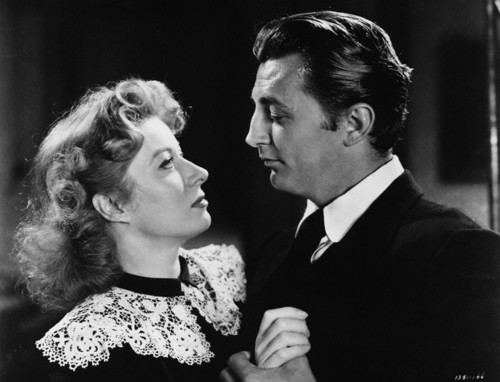
Starring: Greer Garson, Richard Hart and Robert Mitchum

It's pretty safe to say that, well before the end of production on Desire Me, no one wanted to have anything to do with this oft-overlooked picture.

The specialty channel TCM aired the film last week, with host Robert Osborne detailing the multiple cast changes, script rewrites and revolving door of high-profile directors that all culminated in the film's ultimate plummet at the box office. Few remember the film today. This is not the picture that Greer Garson or Robert Mitchum are remembered for, thankfully.

In fact, the most intriguing thing about Desire Me is the fact that it was the first MGM film to be released without a director's name attached. Jack Conway, George Cukor, Mervyn LeRoy and Victor Saville all took a stab at helming the project, but ultimately left for a myriad of reasons -- namely the lack of artistic freedom and Garson's allegedly difficult personality on set.

It was LeRoy who finished the picture in the end, however, none of the directors wanted their names attached to the film so the studio went ahead and released it without crediting anyone.

Desire Me begins with an isolated house set upon the cliffs in Brittany. With a setting more suited to a film adaptation of Wuthering Heights, we discover that it belongs to Marise Aubert (Garson), a woman who is led to believe that her husband, Paul (Mitchum), has died in the field during the Second World War. When a man appears by the name of Jean Renaud (Richard Hart) he claims that he was her husband's closest companion during the war and that he witnessed Paul's death. Marise finds herself drawn to this personable stranger and sets out to lead a life with him as though he were a replacement for her dead husband. Marise and Jean's friendship is frowned upon by the gossipy villagers -- how could two unmarried strangers live together under one roof? As we learn via flashback, Jean is more than content with this living situation, having fallen in love with Marise based on a photo of her and Paul's stories about his loving wife.

As Jean himself claims in one particularly eerie moment: "I wanted to know what it was like to come home to my own house. My own wife."
Garson and Mitchum

While the audience has their guard up and can sense the emotional instability of Jean, he gradually crosses the line from lonely to creepy, with Marise a little slow on the uptake.

The acting, disappointingly, isn't particularly note-worthy. We've all seen Garson and Mitchum in far more engrossing and challenging roles. Granted, both are gifted actors and make due with what little is given to them in the script -- but it just isn't enough to truly rise above the material. Buried deep beneath this half-wartime love story, half-psychological thriller, Desire Me has a better movie waiting to come out.

The cinematography from Joseph Ruttenberg is gorgeous, lending the film a foreboding sense of danger through his keen eye. His visuals, combined with a lack of soundtrack in the climactic finale, briefly helps Desire Me rise above its scattered script. Eyes meeting through the mist, voices echoing along the cliffs, gunshots ringing out in the night, Ruttenberg's work is stunning. His cinematography allows for a sense of consistency in a film that is a narrative mess.

Desire Me is one of those forgotten classic films that you catch on TV late one night and are reminded as to why it has been forgotten in the first place. While there are stylistic elements that are certainly impressive, Desire Me will ultimately leave you cold.

FINAL GRADE: C+

Friday, March 22, 2013

Movie Review: Teenage Mutant Ninja Turtles

The heroes in a half shell.
Teenage Mutant Ninja Turtles (1990)
Directed by: Steve Barron

I reviewed this movie for Next Projection.

Most children of the 80s and 90s grew up on a steady TV diet of their favourite heroes in a half shell. Whether you preferred Michelangelo's surfer dude attitude or Raphael's lone wolf angst, there was no denying the allure of that turtle power.

Loosely based on the Mirage Studios comics, the animated series debuted in 1987 and centred on the adventures of four turtle siblings and their wise master, Splinter. While the series captured the imagination of kids throughout North America, it diverged from the original source — opting instead to change key character elements for the sake of simplicity.

In 1990, New Line Cinema decided to capitalize on this animated success story by distributing a live action adaptation that would ideally appeal to both kids and teens, alike. The end result is not so much a cult classic as a fondly remembered retro rewind — a nostalgic look back at our childhood, a childhood where we once watched a movie about walking, talking turtles who struggled to emulate the wisdom expounded by a life-size rat.

While Teenage Mutant Ninja Turtles: The Movie lacked the mass appeal that enabled films like The Rocky Horror Picture Show — or to a lesser extent, The Goonies — to reach cult status, it still carries a special place in film lore for many of its now-adult fans.

Unlike it's more cartoonish and increasingly ridiculous sequels, The Secret of the Ooze and Teenage Mutant Ninja Turtles III, the first installment in the franchise is surprisingly dark for what essentially amounts to kiddie entertainment — it's stylistically reminiscent of Tim Burton's original Batman, which was released the previous year in 1989.

The premise (as if you didn't already know!) features a quartet of genetically mutated turtles who are regularly trained in martial arts by their mentor, Splinter (voiced by Kevin Clash). The teens must learn to work together as a team in order to defeat Shredder (James Saito) and his violent ninja gang, the Foot Clan. Along the way the turtles form close bonds with an investigative journalist named April O'Neil (Judith Hoag) and a cricket bat-wielding street thug named Casey Jones (Elias Koteas).

With its bleak outlook on city living and gang culture, Teenage Mutant Ninja Turtles comes off as more of a film noir for kids — complete with its own version of a femme fatale and the casual (if sometimes grating) use of the term “babe” to describe attractive women.

Yet, despite everything going against it — being a inconsequential live action film that included men dressed in turtle suits and remote-controlled Jim Henson puppets — Teenage Mutant Ninja Turtles isn't half as bad as you'd think. (Side note: It's thankfully no Garbage Pail Kids, that's for certain; with it's disgusting characters and uncomfortably lame one-liners).

Each turtle are each unique individuals, allowing kids in the audience to pick and choose which hero they can best identify with. There's Donatello (voiced by Corey Feldman) who is often depicted as the intellectual brother due to his aptitude for science and his knack for technological gadgets. There's Leonardo (voiced by Brian Tochi), the unofficial leader of the pack who exhibits both patience and discipline. Or how about Michelangelo (voiced by Robbie Rist), the fun-loving prankster who adores pizza as much as his nun-chucks. Or, finally, my personal childhood favourite, Raphael (voiced by Josh Pais), the lone wolf who exhibits extreme bouts teen angst more than any of his brothers — and struggles to come to terms with it.

It's dark, noirish elements give children the illusion that they are watching an exciting, dangerous adult film. I recall feeling a rush of exhilaration when watching TMNT simply because it looked and felt like grown up movies my parents would enjoy. Credit is due to production designer Roy Forge Smith for cashing in on the success of Burton's bleak Batman while still maintaining his own unique vision of a world inhabited by human-sized turtles and their various nemeses.

For all intents and purposes, Teenage Mutant Ninja Turtles is a hybrid movie: part martial arts action flick, part cartoon-ish adventure and part romance. You could argue that it has a little something for everyone — including adults should they decide to revisit this childhood favourite with their own kids. And why wouldn't they? After all, Teenage Mutant Ninja Turtles is more than just a kid's flick — it illustrates the importance of familial bonds and working together as a team to help the ones you love. And that's total turtle power!

While surprisingly better than one may expect, Teenage Mutant Ninja Turtles is still bogged down by a silly, often scattered, script — yet still manages to be a nice trip down memory lane.

FINAL GRADE: C+

Wednesday, March 13, 2013

Movie Review: A Royal Affair (En Kongelig Affaere)


Mads Mikkelsen, Mikkel Folsgaard & Alicia Vikander

A Royal Affair (2012)
Directed by: Nikolaj Arcel
Starring: Alicia Vikander, Mads Mikkelsen and Mikkel Boe Folsgaard

A Royal Affair (Or: How the European Enlightenment Came to Denmark) narrows in on the illict relationship between a German-born doctor and the British-born queen of the Danes. How these two came to fall passionately in love -- at great risk to themselves -- is at the heart of director Nikolaj Arcel's moving historical drama, a Best Foreign Language Film nominee at the recent Oscars ceremony.

The film opens with a voiceover from Caroline Mathilde (Alicia Vikander), younger sister to England's King George III. Caroline's narration comes in the form of a revealing letter written to her two estranged children back in 1775, in the midst of her rapid fall from power. Caroline details how she came to be the new queen of Denmark -- as a 15-year-old princess married to King Christian VII (Mikkel Boe Folsgaard), a man who at first glance appears to be so emotionally unstable to the point of outright madness. Just as Caroline resigns herself to her fate as a sidelined queen overpowered by a dominant, wild husband, the tides start to shift in her favour. When the king's council seeks a doctor to properly diagnose and address Christian's mental instability, they recruit a small-town German-born doctor named Johann Struensee (Mads Mikkelsen). Put off by the unconventional doctor at first, Caroline soon falls in love with the educated, free-thinking Struensee. The two embark on creating a series of social reforms, persistently bringing the European Enlightenment to Denmark -- a country that Caroline insists is still living in the "dark ages." They enact their reforms through the vulnerable Christian VII, who affectionately refers to his wife as "mother" and idolizes Dr. Struensee like a child to a parental figure. This strange love triangle (of sorts) scandalizes the court, causing the king's devoutly religious and conservative-minded council and his conniving stepmother, Juliane (Trine Dyrholm) to take extreme measures to bring about the utter disgrace of both Struensee and Caroline.

A Royal Affair benefits greatly from that fact that this historical event, and its bloody and tragic outcome, remains largely unknown to North Americans, in general. As a result, audiences are better able to envelope themselves in a world and situation that is unfamiliar to them -- this doesn't feel like your usual historical costume drama re-hash. 

Arcel's film also manages to breath life into its three central characters -- all are equally sympathetic in their own way. You yearn for each to find their own personal happiness, yet there's a shadow that hangs over each of their fates. It's rare to see historical figures painted in such a light -- none of the three  lead figures are perfect, far from. Nothing about their situation is black or white and, as a result, each character reveals their own grey areas: Is Caroline right to use her mentally unstable husband as a puppet king, much like his own council? Is it arrogant of Struensee to think he can change the minds of an entire nation in one fell swoop? And is Christian VII really a devious fiend as first portrayed, or is he really a lost young man not fit to be king and yearning for true friendship?
Vikander and Mikkelsen

With its lush cinematography (you'll want to book a flight to Denmark ASAP) and exquisite costumes, A Royal Affair may look like many other period pieces you've seen before, but where it truly excels is in its revelatory casting.

As Caroline, Vikander portrays the young queen as a strong-willed woman who follows her heart and bides her time before she can truly blossom into a prominent political figure. She's highly educated and is up-to-date on the latest news about Voltaire and Europe's Enlightenment. How refreshing to see such a strong central female figure and Vikander is lovely in the role. 

Mikkelsen is the brash and opinionated Struensee, a man who thinks his way is the right way -- other opinions be damned. He's drawn not only to Caroline's beauty, but her mind and strength of character. A man of the Enlightenment, Struensee strives to bring Denmark into a new world -- albeit while neglecting to realize the consequences of his actions in a country that largely doesn't identify with the European movement.

And, finally, there's Folsgaard as the irascible, yet strangely sympathetic, King Christian VII. Within the opening frames of the film you'd be hard pressed to find positive thing to say about the king. His attitude towards his young wife is appalling and his inability to effectively rule his own people is an embarrassment to Denmark. But, stick around long enough, and you see more of the person beneath the hot-headed exterior. Thanks to Folsgaard's fantastic performance, Christian goes from foul-mouthed brat to a frightened, lonely man trapped within an occupation at which he is incompetent. His reliance on Caroline and Struensee for comfort and entertainment invites a tragic element to the character of Christian and its all perfectly rendered by Folsgaard in his first film role (winner of the Best Actor award at the Berlin Film Festival, the Oscars missed out on nominating Folsgaard for Best Supporting Actor).

A Royal Affair is a beautifully lensed, powerful historical drama. And while its history is absolutely fascinating, it's the characters that will make you want to stay for the long haul.

FINAL GRADE: A-

Thursday, March 7, 2013

Classic Film Review: Good News

Good News (1947)
Directed by: Charles Walters
Based on the play by: Lew Brown et al.
Starring: June Allyson and Peter Lawford

Chances are, if you are looking for a good old-fashioned musical from the 40s and 50s, your first stop would be MGM -- the major studio that produced Singin' in the Rain, The Wizard of Oz, West Side Story, Meet Me in St. Louis and Showboat, among others.

For every Gene Kelly pirouette and Judy Garland solo, there are those lesser-known gems from MGM that would otherwise be completely forgotten if not for specialty channels like TCM

And, considering the DVD is next to impossible to track down, TCM may be the only way classic film buffs can view (and own) director Charles Walters' thoroughly enjoyable adaptation of the college-set musical, Good News.

It's a familiar premise, one we've seen in countless musicals and romantic comedies over the decades: A college football captain named Tommy Marlowe (Peter Lawford) falls head-over-heels for the campus' beautiful, wealthy "it" girl, Pat McClellan (Patricia Marshall). When Pat rejects Tommy's advances, he discovers her passion for the French language and vows to become fluent himself in an attempt to woo her. He enlists the help of brainiac Connie Lane (June Allyson), and she sets aside time from her busy schedule to tutor him in French. And then, wouldn't you know it, Connie finds herself smitten with the star athlete. It's your standard tale of (seemingly) unrequited love set to bouncy music, vivid technicolour and show-stopping dance numbers.

All musicals require a suspension of disbelief, arguably even moreso than any other genre. People, often complete strangers, are liable to break out into a perfectly synchronized song and dance routine -- only to resume their everyday activities the moment the song reaches its concluding notes.

However, Good News unintentionally requires its viewers to suspend their disbelief even further with one particular gaping plot hole and a couple of contrived situations that strain plausibility.

The gaping plot hole? Well, that would be the fact that the film claims it's set in the 20s when, in actual fact, all the costumes and hair-styles are very clearly contemporary (i.e. circa 1947). And the plot contrivances? It would be too long-winded to list here but, in a nutshell, Tommy finds himself torn between winning the final football game of the season and proposing to Pat after the victory or losing the game on purpose to win over the affections of the bookish Connie.
Peter Lawford and June Allyson

Regardless of these quibbles, it's hard not enjoy this rousing musical. The songs are surprisingly catchy considering the film has fallen off the radar when people talk about movie musicals. You'll find yourself humming "Lucky in Love" well after the end credits. And, while "The Best Things in Life are Free" is no doubt viewed as the film's romantic highlight, keep an eye out for the amusing exchange between the charming Allyson and Lawford when they duet on "The French Lesson."

In terms of genuine show-stoppers, however, there's only one that comes to mind: "Pass the Peace Pipe", an infectious song-and-dance number led by Joan McCracken (professional dancer and ex-wife of Bob Fosse).

But what it all comes down to in the end is the two charming leads. While Allyson and Lawford both have their detractors, I'm not one of them -- they are both a joy to watch. While they may not have the greatest singing voices they try their darndest to really belt it out. Where they do both excel is in their onscreen presence and overall likeability -- and both are fully capable of burning up the dance floor as they prove in the closing number, "The Varsity Drag."

For pure, unadulterated musical entertainment, Good News proves to be just that.

FINAL GRADE: B+