Showing posts with label book review 2011. Show all posts

Sunday, June 26, 2011

Book Review: Dark Victory - The Life of Bette Davis


Dark Victory: The Life of Bette Davis (Published 2008)
By: Ed Sikov

The title is misleading. Those expecting a full-length biography of the life of screen legend Bette Davis should look elsewhere. That's not to say that film critic Ed Sikov's book isn't worth a read -- only that it is somewhat misrepresented as something it is not. 

It's not so much a biography as a glimpse of the film sets for each one of Davis' films, plays and television appearances. Sikov, being a critic, instead discusses her performance in each piece and provides an analysis of her abilities in each role, with only brief glimpses of what was going on in her personal life at the time. 

Warners Brothers co-creator, Jack Warner, once described Davis as "an explosive little broad with a sharp left." When Sikov quotes great lines like that you can't help but wish a little more emphasis had been placed on Davis not only as an artist, but as a complex person. Married three times (all tumultuous, sometimes abusive, relationships), with a raspy voice, heavy drinking problem and a smoking habit that could rival all the chain smokers the world over, Davis was so much more than just her body of work. I suppose I was expecting a biography in the more traditional sense -- discussion of the subjects career with an equal balance of focus on their life away from work. 

Davis is my favourite actress and I'd never read a book on her before. While Sikov provides insightful and fascinating interpretations and opinions on her performances and her on-set behaviour, I was also hoping to learn a lot more about her legendary rivalry with diva-extrodinaire Joan Crawford, her strained relationship with her daughter, B.D., and whether or not people truly believed that the injury she caused her second husband, Arthur Farnsworth, actually caused his premature death while still in his 30s. Davis was forever surrounded by controversy and damaged relationships -- from a broken home that included a distant father, an overbearing mother and a mentally ill younger sister, to three disastrous marriages and an estranged daughter. In addition to her personal woes -- which made for great tabloid fodder -- Davis was also known as being one of the most difficult actresses in Hollywood to work with and was rumoured to have had numerous affairs over the years with everyone from her directors to her co-stars, including actor Errol Flynn. 

However, even though the focus of Dark Victory wasn't quite what was expected, it's still a superior source on Davis compared to some other resources available. Sikov perceptively illustrates how Davis often utilized her personal issues to transform whatever character she was playing at the time into a fully realized and complex human being. Like other screen legends both before and after her success, Davis understood that acting was a unique art form that should be respected, discussed and left open for interpretation. 

Although she was difficult to work with and had countless battles with Warner Brothers over her rights to portray her characters as she deemed fit, no one would dare dispute that she was fully committed to her career -- even when forced by the the old school studio system in Hollywood to appear in films with lousy scripts and dull characters. While Davis always made the best of each situation when it came to her film career, her personal life was always in need of more attention; but she ultimately neglected her responsibilities in that area of her life. 

Davis was a woman ahead of her time, always ahead of the curve -- someone who sassed back at studios when she disagreed with something; a woman who wore pants, cursed like a sailor and once refused to offer her "services" to a theatre producer in exchange for a starring role. Sikov does an admirable job of portraying Davis exactly as she was, even going so far as to note in his introduction that the reader may come away from Dark Victory not liking Davis very much as a person -- but Davis never sought public approval. 

Although not quite a biography, Dark Victory provides well-researched insight into one of the most fascinating women to ever grace the silver screen. 

I was originally going to put up an interview, but I came across this fan video instead. (Music: "Bette Davis Eyes" by Kim Carnes). 

Tuesday, February 1, 2011

Hollywood Tidbits: Some Like It Hot (Part II)

The continuation from my previous entry on Tony Curtis' The Making of Some Like It Hot (2009).

One of my friends asked that I post some more bite-size quotes from the book (which I've almost completed).

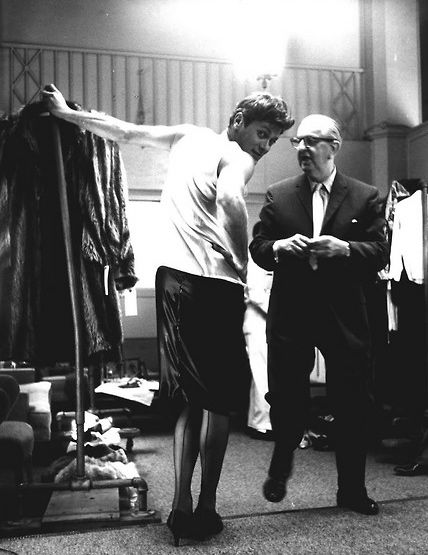
* How Tony Curtis managed long hours on the set without taking washroom breaks: “I put my thinking cap on and built a funnel-and-hose thing. It went around my thigh, down the inner side of one leg, and was hidden inside the silk stocking that I was wearing. I didn’t have to stand up or sit down. It wasn’t all that comfortable, but it worked. I should have taken out a patent on it …One day Jack (Lemmon) caught me in the men’s room. I was adjusting the thing. 'What the fuck are you doing?' he asked. 'Never mind,' I answered. 'I’m inventing something.' I didn’t tell him because he might judge me. He was kind of conservative in an odd way." (p. 82)


 Billy Wilder and his perfectionism: “I remember the scene in Poliakoff’s office, the agency where Jack and I are scrounging for work. Jack got excited, and after finishing a speech with the line ‘Now you’re talking,’ he repeated the line. Billy froze. ‘That’s not how the speech reads,’ he said. Jack pleaded. It felt right to him to say the line twice. Billy walked over to Izzy (co-screenwriter I.A.L. Diamond), who was sitting a short distance away. They started talking in low tones. This went on for close to half an hour. He finally came back to us. ‘Okay, you can repeat it,’ he said solemnly." (p. 111) 

* Marilyn Monroe once took 81 takes before nailing a scene which required her to speak only one simple line - 'Where's that bourbon?' - She directed her frustration at Billy Wilder: "Jack and I were like two bad little kids in school. We wanted to laugh out loud so badly, but we had to turn away and do it into our hands. It was fucking outrageous. Next Billy tried putting cue cards inside the drawers. Even that didn't help. But he had to get the shot. There was no way to cut around it. I wish I'd bet a thousand dollars on eighty takes. It took eighty-one. 'I swallowed my pride,' recalled Billy. 'If she showed up, she delivered, and if it took eighty takes, I lived with eighty takes, because the eighty-first was very good.' Cut. Print. Faint." (p. 167). 

* Curtis always seemed to be in awe of Jack Lemmon: "I was delighted to have Jack as a costar. He could be theatrical without worrying if he was making a fool of himself. He was comfortable in his own skin. That giggle he did as Daphne wasn't just clever. It was brilliant. Jack didn't mention his personal life at work. We both came from a certain tradition. When you were on the job, you never discussed politics, religion, family or sex. It just wasn't done in those days. But when I saw him at Hollywood parties, he had a glass of whiskey in his hand and he was more forthcoming ...A lot of men who are gentle need to drink because they're embarrassed about not being cavemen. That's my theory,  anyway." (p. 159)

++ I find this passage really interesting because, if you've read the book, it's yet another example of Curtis being literally in awe of Lemmon's ability as both a comedic actor and as a human being. Curtis rarely wrote about Lemmon in The Making of Some Like It Hot (he tended to focus more on Monroe and Wilder), but when he did mention Lemmon, it was always respectful and tasteful. Curtis denied being jealous of Lemmon's talent but I wonder how true that really was because of how he writes about Lemmon -- both praising him and also pushing him into the background in favour of Monroe and Wilder. One thing I think Curtis does convey really well is the simple fact that Jack Lemmon was a class act. And Hollywood doesn't make them like that anymore. 

Thursday, January 27, 2011

Hollywood Tidbits: Some Like It Hot

My obsession with Some Like It Hot continues, one year later.

I got the late, great Tony Curtis' last book, The Making of Some Like It Hot: My Memories of Marilyn Monroe and the Classic American Movie for Christmas. I started reading it this morning and I haven't been able to put it down.

Curtis had a really simple, engaging style of writing. It's more conversational -- like he's narrating this high point in his film career directly onto the page.

There are those (film critics, celebrities and the general public) who label Curtis as an outright liar and paint him as an opportunistic man prone to exaggeration. Did he or did he not impregnate Marilyn Monroe? Did they really have a torrid, top secret romance? Curtis says yes, while others point out that Monroe isn't around to tell her side of the story. Nor is the film's director Billy Wilder or his co-star Jack Lemmon. Curtis wrote his book in 2009, many, many years after the deaths of Monroe, Lemmon and Wilder (and a year before his own).

Regardless, I take everything Curtis wrote with a grain of salt. I know to make sure I don't fall into any traps as I read The Making of Some Like It Hot. But damned if the man doesn't spin a great behind-the-scenes yarn. I'm a sucker for those largely unknown Hollywood dramas that often played out in between takes, I'm only 60 pages into the book, but here are some interesting (and likely true) tidbits in this gospel according to Curtis:

* He was once roommates with Marlon Brando for four months: "I respected him. But I wasn't interested in the Method. He was great because he was Marlon, not because of the Method. I thought it was phoney. Why complicate the job of acting? Memorize your lines. Learn the part. Find out what the director wants. Then show up on time and act. This idea of trying to remember when your sister stole your peanut butter sandwich so you can give an angry performance is bullshit. If you can't turn it on by yourself, you don't belong in front of the camera." (p.39)

++ An interesting commentary on the much respected Method acting technique (introduced by Brando), to say the least.

* Marilyn Monroe's intelligence: "Marilyn was not unintelligent. She was bright, perceptive and insightful -- but only about other people. When it came to herself, or to issues relating to herself, she didn't have a clue. She needed constant reassurance." (p.39)

* His first encounter with Marilyn: "We walked to my car and I opened the door for her. I got behind the wheel, drove out the gate, and turned left, heading for Hollywood. I angled the review mirror a little so I could see her face. To my surprise she winked at me. We laughed." (p.31)

* The first time he and Jack Lemmon walked in front of the cast and crew dressed as women: "I blushed under the makeup and let the actor in me take over. I launched into a little routine. I was coy. I was reluctant ...When Jack came out he did it in a big way. He was in character as Daphne. He flew out, twirling and pirouetting. He danced ...I just stared. How the fuck could he do that? I was envious, but it was the first and last time. I loved the guy." (p. 59)